
Press Council of India

Indian journalism editor reviewing newspapers and digital news in a modern newsroom workspace

Indian Editors in Journalism: Historical Evolution, Institutional Role, and Editorial Responsibilities
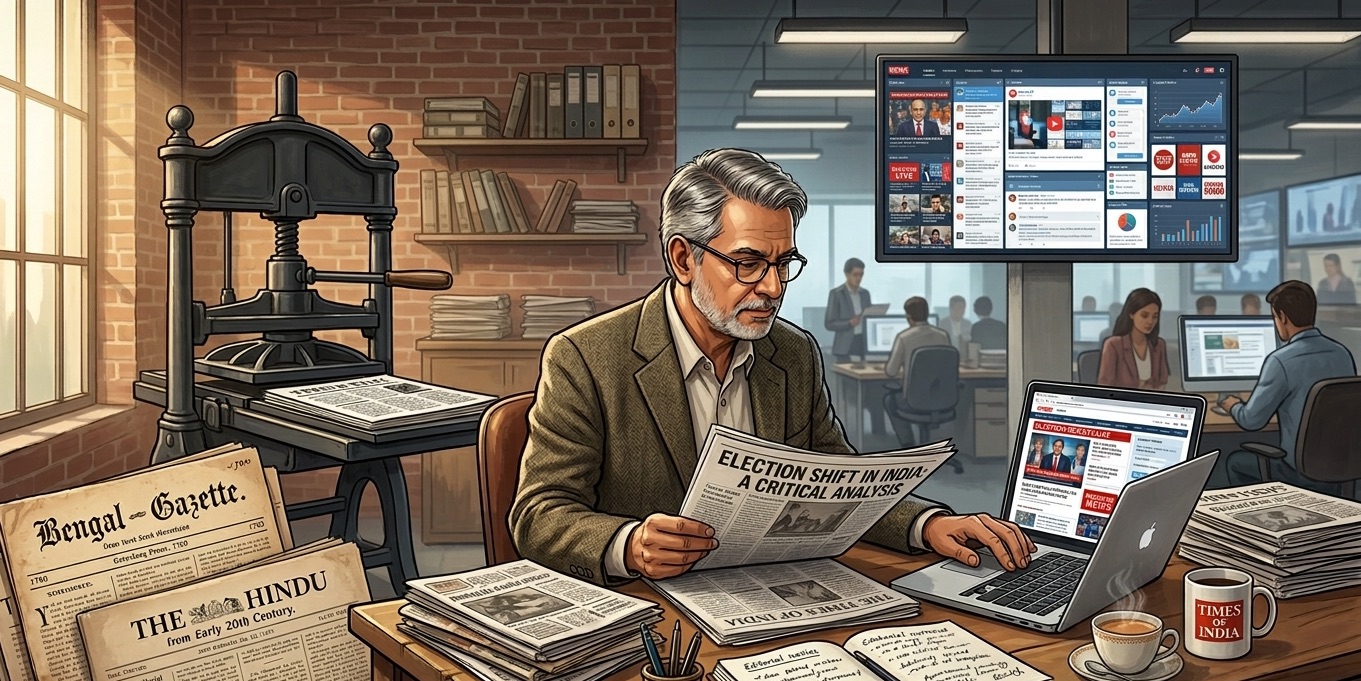
Editors occupy one of the most influential positions within the institutional structure of journalism. In any newsroom, the editor functions as the central authority responsible for determining how information is gathered, verified, and presented to the public. In India, editorial leadership has historically extended far beyond routine newsroom management. Editors have often acted as intellectual […]

Indian Editors in Journalism: Historical Evolution, Institutional Role, and Editorial Responsibilities Read More ยป

The Press Council of India is a:ย 

The Press Council of India is a:  (A) non-judicial body (B) private entity (C) non-statutory body (D) quasi-judicial body Correct Ans: (D) Explanation:The Press Council of India (PCI) plays a vital role in safeguarding journalistic standards and press freedom. Established under the Press Council Act of 1978, it functions as a quasi-judicial body. This means

The Press Council of India is a:ย  Read More ยป

Sequence of Chairmanship in the Press Council of India

Find out the correct sequence of the chairmanship of the Press Council of India: (A) Justice A. N. Sen, Justice R.S. Sarkaria, Justice P.B Sawant, Justice G.N. Ray (B) Justice R.S. Sarkaria, Justice G.N. Ray, Justice A. N. Sen, Justice P.B Sawant (C) Justice P.B. Sawant, Justice A.N. Sen, Justice G.N. Ray, Justice R.S. Sarkaria

Sequence of Chairmanship in the Press Council of India Read More ยป

The first chairman of the Press Council of India was

The first chairman of the Press Council of India was (A) Justice Rajagopala Iyenger (B) Justice P. B Sawant (C) Justice Jeevan Reddy (D) Justice J.R. Mudholkar Correct Ans: (D) Explanation: Justice J.R. Mudholkar was the first chairman of the Press Council of India (PCI). The government established PCI in 1966 to maintain journalistic ethics

The first chairman of the Press Council of India was Read More ยป

Second press commission of India did not favour a code of ethics

The second press commission of India did not favour a code of ethics that was (A) Informal  (B) Formal (C) personal (D) substantial Correct Ans: (B) Explanation: The Second Press Commission of India did not support a formal code of ethics for journalists. Instead, it emphasized self-regulation over strict legal enforcement. The commission believed that

Second press commission of India did not favour a code of ethics Read More ยป

The Second Press Commission of India recommended

The Second Press Commission of India recommended the establishment of (A) Press Council of India (B) National Media Training Institute (C) Newspaper Development Corporation (D) Media Competition Commission Correct Ans: (C) Explanation: The Second Press Commission of India played a significant role in shaping media policies. It aimed to strengthen the newspaper industry by ensuring

The Second Press Commission of India recommended Read More ยป

Chronological Order of Press Council of India Chairpersons

Identify the correct sequence of the following Chairpersons of the Press Council of India: (A) Justice T.S. Rajagopala Iyengar, Justice P. B Sawant, Justice G.N. Ray, Justice Markandeya Katju (B) Justice P. B Sawant, Justice G.N. Ray, Justice Markandeya Katju, Justice T.S. Rajagopala Iyengar (C) Justice G.N. Ray, Justice Markandeya Katju, Justice T.S. Rajagopala Iyengar,

Chronological Order of Press Council of India Chairpersons Read More ยป

Understanding Media Self-Regulation in India

Assertion (A): Self-regulation by media in India is a Myth. Reason (R): Media tabloidization is a reality in India and there is no statutory code of ethics to control them. (A) Both (A) and (R) are true. (B) Both (A) and (R) are true, but (R) is not the correct explanation of (A). (C) (A)

Understanding Media Self-Regulation in India Read More ยป

Scroll to Top