Advertising success depends not only on creative messages or media selection but also on when and how often advertisements appear before the audience. This strategic planning of advertising placements over time and across media channels is known as media scheduling.
Media scheduling functions as the timeline or calendar of an advertising campaign, determining the timing, duration, and pattern of advertisements across media platforms. Through effective scheduling, advertisers align their media spending with consumer purchasing cycles, campaign objectives, and market demand. A well-designed schedule ensures that advertisements reach audiences at the most influential moments, thereby improving campaign effectiveness.
Core Elements of Media Scheduling: Reach, Frequency, and Continuity
Before selecting a scheduling strategy, media planners balance three key elements commonly known as the RFC framework: Reach, Frequency, and Continuity.
Reach
Reach refers to the number of unique individuals or households exposed to an advertisement at least once during a specific time period. It measures the breadth of audience exposure and is particularly important for campaigns aimed at building rapid brand awareness, such as new product launches or market entry campaigns (Belch & Belch, 2012).
Frequency
Frequency represents the average number of times a target audience member is exposed to the advertising message within a given period. Repeated exposure strengthens message recall and increases the likelihood that consumers will remember the brand during the purchase decision process. However, excessive repetition may lead to advertising wearout, where audiences become bored or irritated by repeated messages (Batra, Myers & Aaker, 1996).
Continuity
Continuity describes the pattern of advertising distribution over time. It addresses the question of whether advertisements should run continuously throughout a campaign or appear only during specific periods. Different continuity patterns form the basis of media scheduling strategies.
Major Media Scheduling Strategies
Media planners typically rely on three major scheduling strategies. These strategies differ in the pattern or “pulse” of advertising activity over time.
Continuous Scheduling
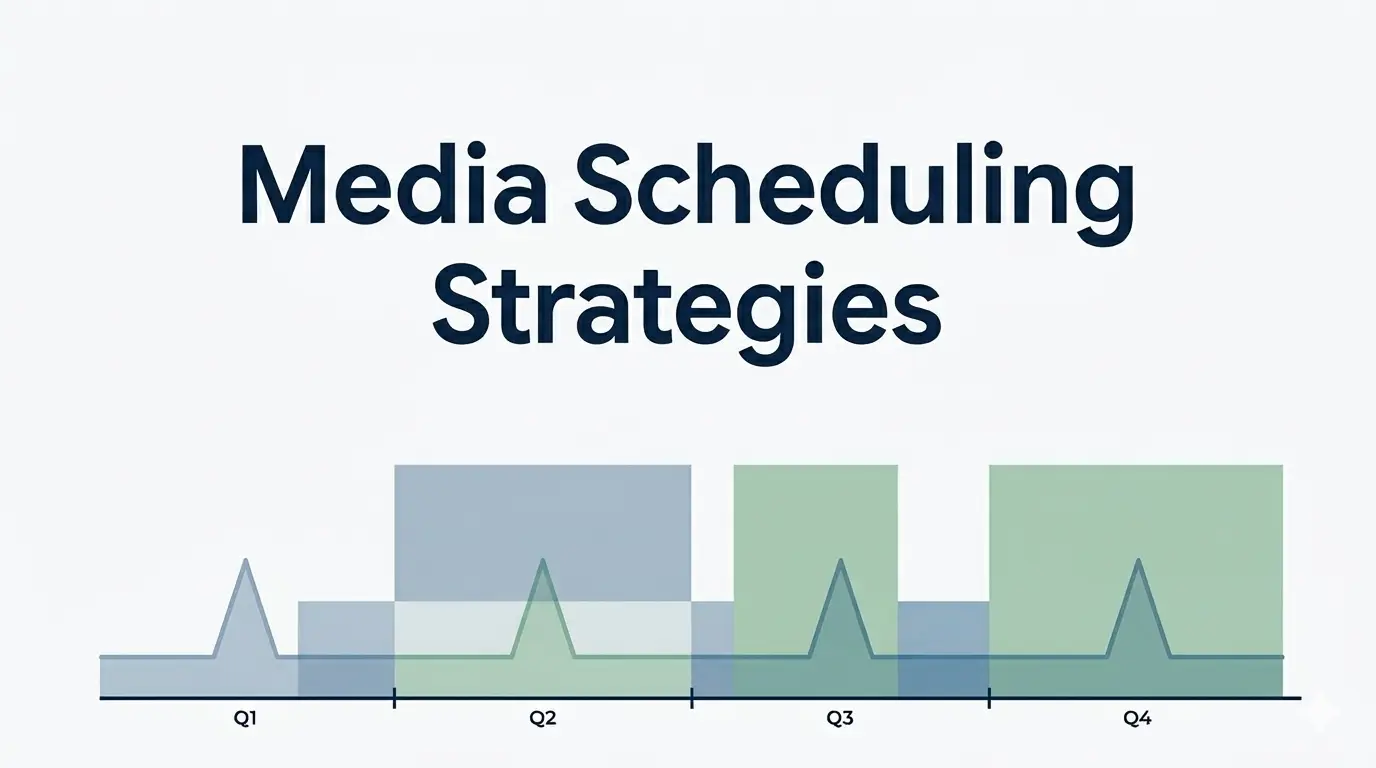
Continuous scheduling refers to a strategy in which advertisements run at a consistent and stable level throughout the entire campaign period, often across the entire year. In this approach, advertising exposure remains relatively constant, ensuring that the brand remains visible to consumers whenever they enter the buying cycle. Continuous scheduling is particularly useful for products that experience steady, year-round demand.
Typical examples include everyday consumer goods such as:
- Toothpaste
- Soap
- Milk
- Laundry detergents
Since these products are purchased frequently, maintaining constant brand presence helps reinforce brand familiarity and supports repeat purchasing behavior (Belch & Belch, 2012).
Flighting Scheduling
Flighting scheduling is an intermittent advertising strategy in which periods of intense advertising are followed by periods with no advertising activity. The active advertising phases are called flights, while the inactive intervals are known as off-air or grounded periods. In this model, advertisers concentrate their budget during periods when consumer demand is expected to be highest.
Flighting scheduling is most commonly used for seasonal products or services, such as:
- Air conditioners and ceiling fans during summer
- Cold creams during winter
- Seasonal healthcare products such as Vicks Balm and cold remedies during winter
This strategy allows advertisers to maximize advertising impact while avoiding the cost of year-round advertising, making it especially suitable for brands with limited advertising budgets (Batra, Myers & Aaker, 1996).
Pulsing Scheduling
Pulsing scheduling combines elements of both continuous and flighting strategies. In this approach, a baseline level of advertising is maintained throughout the year, while advertising intensity increases during peak demand periods. This strategy ensures that the brand maintains continuous visibility while also receiving additional promotional support during high-consumption periods.
For example, soft drink brands maintain reminder advertising throughout the year but increase advertising significantly during summer months, holidays, and major sporting events, when demand is highest.
Additional Media Scheduling Variations
In addition to the three main strategies, advertisers sometimes use specialized or extended scheduling variations designed to meet specific campaign objectives.
Start-Up Pulse
A start-up pulse involves a large and concentrated burst of advertising at the beginning of a campaign. This approach helps create rapid awareness and establish strong market presence for new products or services.
Promotional Pulse
Promotional pulse refers to short-term advertising bursts tied to specific promotional events, such as festive sales campaigns, clearance sales, or limited-time retail promotions.
Erratic Pulse
Erratic pulse describes an irregular and unpredictable advertising pattern that does not follow a fixed seasonal or cyclical schedule. This strategy is sometimes used to disrupt competitors’ advertising patterns or respond quickly to changing market conditions.
Comparison of Media Scheduling Strategies
- Continuous scheduling maintains stable exposure across the campaign period, ensuring consistent brand visibility but requiring substantial financial investment.
- Flighting scheduling concentrates advertising during selected periods, producing strong impact when demand is highest while eliminating costs during inactive periods.
- Pulsing scheduling offers a balanced approach by maintaining continuous exposure while intensifying advertising during peak consumption periods.
- Each strategy is selected based on product characteristics, market demand patterns, and advertising budgets.
Media Scheduling in Contemporary Advertising
- Modern media planning involves scheduling advertisements across both traditional and digital platforms.
- In television advertising, planners determine the most effective dayparts—such as morning, afternoon, prime time, or late-night slots—to reach target audiences. National advertisers frequently combine network advertising for broad reach with local spot advertising to support regional markets.
- Digital media has expanded scheduling possibilities even further. Advertisers can now use targeted advertising, programmatic buying, and audience-based delivery systems to reach consumers based on their browsing behavior and interests.
- Media planners also use Gross Rating Points (GRPs), calculated by multiplying reach and frequency, to estimate the overall weight or delivery intensity of an advertising campaign. GRPs indicate the total weight or delivery intensity of an advertising campaign.
Conclusion
Media scheduling is a critical component of advertising strategy. By carefully planning the timing and pattern of advertising exposure, marketers can ensure that messages reach the right audience at the most influential moments. Continuous, flighting, and pulsing scheduling strategies each serve distinct marketing objectives depending on product demand cycles, advertising budgets, and campaign goals. Effective media planning therefore requires selecting and balancing these strategies to maximize audience engagement while maintaining cost efficiency.
References
- Belch, G. E., & Belch, M. A. (2012). Advertising and Promotion: An Integrated Marketing Communications Perspective. New York: McGraw-Hill.
- Batra, R., Myers, J. G., & Aaker, D. A. (1996). Advertising Management. Upper Saddle River, NJ: Prentice Hall.
- IGNOU. (n.d.). Media Planning and Scheduling. https://egyankosh.ac.in/bitstream/123456789/108100/1/Unit-6.pdf
- Integrated Campaign Planning. (n.d.). Media Scheduling Strategies: Pulse and Flighting. https://journalism.university/integrated-campaign-planning/media-scheduling-strategies-pulse-flighting/