
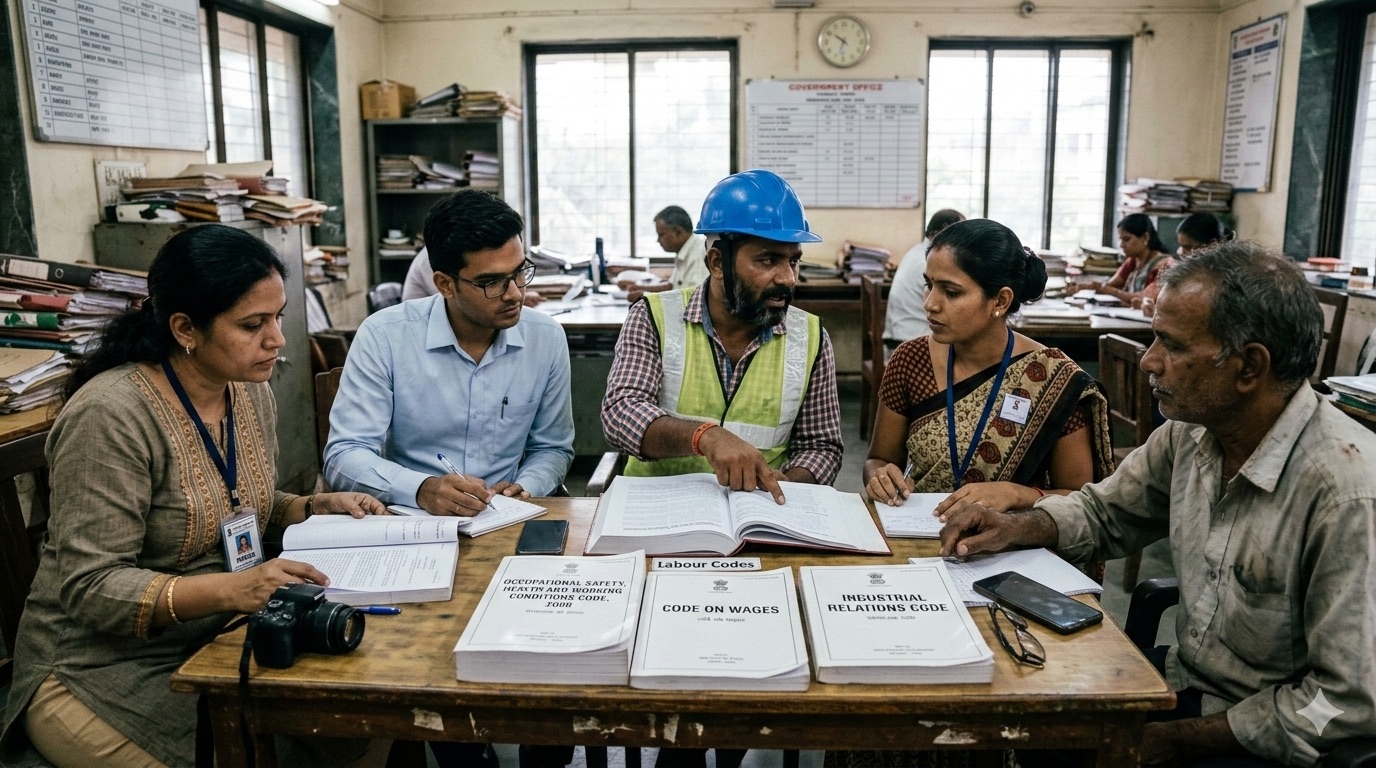
Labour laws in India regulate the relationship between employers, employees, and trade unions. These laws protect workers’ rights, ensure fair wages, and maintain workplace safety. They also help create a balanced system of industrial relations. Over time, India developed a detailed framework of labour legislation. This framework covers wages, social security, working conditions, and the welfare of different groups of workers.
For many decades, India’s labour regulation system was governed by 29 central labour laws. These laws were introduced at different stages of industrial development. As a result, they addressed issues such as worker protection, industrial disputes, and social welfare. However, the system gradually became complex because many laws overlapped with each other. Therefore, the Government of India introduced four Labour Codes between 2019 and 2020. These codes aim to consolidate and simplify the earlier labour laws. They also attempt to create a more unified and modern legal framework. Understanding the earlier labour laws remains important. They laid the foundation of India’s labour policy and continue to influence the present labour code structure.
Historical Development of Labour Laws in India
The evolution of labour laws in India is closely linked with the country’s industrial and social development. During the colonial period, early labour laws mainly regulated working conditions in factories and plantations. At that time, the focus was limited. Nevertheless, these laws introduced basic safeguards for workers.
After independence in 1947, India expanded its labour legislation significantly. The government introduced several new laws to regulate wages and establish social security systems. In addition, these laws protected workers from exploitation. They also recognized the role of trade unions and provided mechanisms for resolving industrial disputes. By the early twenty-first century, the labour law system had become quite complex. Multiple laws governed similar areas of employment. Consequently, compliance became difficult for both employers and workers. To address this issue, the Government of India decided to consolidate the existing labour laws into four comprehensive labour codes.
The 29 Major Labour Laws in India
Before the introduction of the Labour Codes, India had 29 central labour laws regulating different aspects of employment and worker welfare. The following table summarises the major labour laws that existed before the labour code reforms.
| No. | Labour Act | Year | Purpose |
| 1 | Employees’ Compensation Act | 1923 | Compensation for workplace injury or death |
| 2 | Trade Unions Act | 1926 | Legal recognition of trade unions |
| 3 | Payment of Wages Act | 1936 | Ensures timely payment of wages |
| 4 | Industrial Employment (Standing Orders) Act | 1946 | Defines employment conditions |
| 5 | Industrial Disputes Act | 1947 | Settlement of industrial disputes |
| 6 | Factories Act | 1948 | Health and safety of factory workers |
| 7 | Minimum Wages Act | 1948 | Fixation of minimum wages |
| 8 | Employees’ State Insurance Act | 1948 | Medical and social security benefits |
| 9 | Plantations Labour Act | 1951 | Welfare provisions for plantation workers |
| 10 | Employees’ Provident Funds Act | 1952 | Retirement savings |
| 11 | Mines Act | 1952 | Safety in mining sector |
| 12 | Working Journalists Act | 1955 | Service conditions of journalists |
| 13 | Motor Transport Workers Act | 1961 | Working conditions in transport sector |
| 14 | Maternity Benefit Act | 1961 | Paid maternity leave |
| 15 | Beedi and Cigar Workers Act | 1966 | Welfare in beedi industry |
| 16 | Payment of Bonus Act | 1965 | Mandatory bonus payment |
| 17 | Contract Labour Act | 1970 | Regulation of contract labour |
| 18 | Payment of Gratuity Act | 1972 | Gratuity after service |
| 19 | Equal Remuneration Act | 1976 | Equal pay for men and women |
| 20 | Inter-State Migrant Workmen Act | 1979 | Protection of migrant workers |
| 21 | Child Labour Act | 1986 | Regulation of child labour |
| 22 | Cine Workers Act | 1981 | Protection of film workers |
| 23 | Dock Workers Act | 1986 | Safety of dock workers |
| 24 | Building and Construction Workers Act | 1996 | Welfare of construction workers |
| 25 | Building and Construction Workers Welfare Cess Act | 1996 | Welfare fund |
| 26 | Unorganised Workers Social Security Act | 2008 | Social security for informal sector |
| 27 | Sales Promotion Employees Act | 1976 | Conditions of sales employees |
| 28 | Working Journalists Wage Fixation Act | 1958 | Wage regulation for journalists |
| 29 | Labour Laws (Exemption from Furnishing Returns) Act | 1988 | Simplifies reporting compliance |
These laws can be broadly grouped into different categories.
Wage-Related Laws
These laws ensured fair payment of wages and prevented discrimination in remuneration.
- Payment of Wages Act, 1936 – Ensures that workers receive wages on time and prevents unauthorized deductions by employers.
- Minimum Wages Act, 1948 – Empowers governments to fix minimum wage rates in scheduled employments and protects workers from extremely low wages.
- Payment of Bonus Act, 1965 – Requires employers to provide bonuses to employees based on profits or productivity.
- Equal Remuneration Act, 1976 – Mandates equal pay for men and women performing the same work and prohibits gender-based discrimination in recruitment.
- Its provisions are now incorporated into the Code on Wages, 2019
Industrial Relations Laws
Industrial relations laws govern relationships between workers, employers, and trade unions.
- Trade Unions Act, 1926 – Provides legal recognition to trade unions and allows workers to organize collectively.
- Industrial Employment (Standing Orders) Act, 1946 – Requires employers to clearly define employment conditions, including working hours and disciplinary procedures.
- Industrial Disputes Act, 1947 – Establishes mechanisms for resolving industrial disputes through conciliation, arbitration, and labour courts.
Social Security Laws
It aimed to provide financial protection and welfare benefits to workers.
- Employees’ Compensation Act, 1923 – Provides compensation in cases of workplace injury, disability, or death.
- Employees’ State Insurance Act, 1948 – Introduces health insurance and social security benefits for workers.
- Employees’ Provident Funds and Miscellaneous Provisions Act, 1952 – Creates a retirement savings system with contributions from employers and employees.
- Payment of Gratuity Act, 1972 – Ensures gratuity payment after employees complete a specific period of service.
- Maternity Benefit Act, 1961 – Grants maternity leave and related benefits to women employees, later expanded to 26 weeks of paid maternity leave.
Occupational Safety and Working Conditions Laws
These laws regulate working environments and establish safety standards.
- Factories Act, 1948 – Addresses health, safety, and welfare of factory workers.
- Mines Act, 1952 – Regulates safety conditions and working standards in mining operations.
- Plantations Labour Act, 1951 – Provides welfare facilities such as housing, medical services, and education for plantation workers.
- Motor Transport Workers Act, 1961 – Regulates working conditions for employees in the transport sector.
- Contract Labour (Regulation and Abolition) Act, 1970 – Controls employment of contract labour and aims to prevent exploitation.
- Inter-State Migrant Workmen Act, 1979 – Protects workers who migrate from one state to another for employment.
- Building and Other Construction Workers Act, 1996 – Establishes safety standards and welfare measures for construction workers.
Labour Laws for Specific Groups of Workers
Some laws focus on protecting workers in specific industries or vulnerable categories.
- Working Journalists and Other Newspaper Employees Act, 1955 – Regulates service conditions and wages for journalists.
- Beedi and Cigar Workers (Conditions of Employment) Act, 1966 – Ensures welfare and regulates employment in the beedi industry.
- Cine Workers and Cinema Theatre Workers Act, 1981 – Protects workers employed in the film and cinema theatre sector.
- Child Labour (Prohibition and Regulation) Act, 1986 – Restricts the employment of children in hazardous occupations.
- The 2016 amendment further strengthened the law by prohibiting employment of children below 14 years of age in most occupations.
Consolidation into the Four Labour Codes
To simplify labour legislation and improve compliance, the Government of India consolidated the 29 central labour laws into four comprehensive labour codes between 2019 and 2020.
These include:
• Code on Wages, 2019
• Industrial Relations Code, 2020
• Code on Social Security, 2020
• Occupational Safety, Health and Working Conditions Code, 2020
These codes aim to simplify labour regulations, improve worker protection, and align labour laws with modern employment practices, including gig and platform work. The reforms also aim to improve ease of doing business while ensuring adequate safeguards for workers.
Conclusion
Labour laws in India have evolved over many decades to protect workers and regulate employment conditions across industries. The earlier framework of 29 central labour laws addressed various aspects of wages, social security, workplace safety, and industrial relations. The introduction of the four Labour Codes represents an effort to modernize and simplify this complex system while preserving the core objective of labour legislation: protecting workers and promoting fair and productive workplaces.
References
- Government of India. (n.d.). New labour code for new India: Biggest labour reforms in independent India.
- Press Information Bureau. (n.d.). Labour reforms and labour codes press release.
- Ministry of Labour and Employment, Government of India. (n.d.). Labour law reforms documentation.
- Chief Labour Commissioner (Central), Government of India. (n.d.). Labour law portal.
- NCIB. (n.d.). Compilation of labour acts in India.