In the field of mass communication studies, theoretical models have gradually evolved from simple linear explanations to more complex understandings of human interaction. Early theories often portrayed audiences as passive recipients of media messages. One of the most prominent examples was the Bullet Theory, also known as the Hypodermic Needle Model, which suggested that media messages directly and powerfully influenced audiences.
According to this early perspective, communication functioned like a one-way process in which a communicator transmitted a message to a passive audience. The audience was assumed to react automatically to the message, producing predictable social or psychological effects. However, later research revealed that audiences rarely behave in such a mechanical way. Individuals actively interpret and evaluate messages rather than accepting them automatically. This realization led scholars to develop new models that emphasized audience participation and interpretation.
Within this shift, Wilbur Schramm’s Field of Experience (Frame of Reference) concept emerged as a crucial explanation of how communication actually works. The theory suggests that communication does not occur in isolation. Instead, individuals interpret messages through their own experiences, knowledge, beliefs, and cultural backgrounds. Meaning therefore does not exist in the message alone; it emerges through the interaction between the communicator and the receiver. This idea fundamentally transformed the understanding of communication, moving from a simple transmission model to a more interactive and socially grounded approach.
Scholar and Theoretical Background
Wilbur Schramm is widely regarded as one of the founding scholars of modern communication studies. Through his research and teaching, Schramm helped establish communication as an academic discipline and introduced several influential models that explain how messages are produced, transmitted, and interpreted. In his early work during the 1950s and later in the revised edition of “The Process and Effects of Mass Communication” (1971), Schramm challenged the simplistic assumptions of early communication theories. Earlier models were strongly influenced by stimulus-response psychology, which suggested that communication functioned like a direct cause-and-effect process.
Schramm argued that such explanations were insufficient because they ignored the complexity of human perception and social context. Communication does not simply produce automatic responses; instead, individuals interpret messages through their own psychological and social frameworks. To develop a more accurate explanation, Schramm built upon the work of psychologist Charles E. Osgood, who proposed an interactive communication model. Together, their ideas formed what is commonly known as the Osgood–Schramm Model of Communication, which views communication as a circular and transactional process rather than a linear transmission.
Evolution from the Bullet Theory
Early communication research often relied on the Bullet Theory, which described the audience as a passive target. According to this theory, communicators could transmit ideas directly into the minds of receivers, producing immediate and predictable effects. This assumption reflected the social context of early twentieth-century media research, when scholars believed that powerful mass media such as newspapers and radio could strongly influence public opinion.
However, empirical research gradually demonstrated that audiences did not behave as passive targets. People frequently ignored media messages, selectively interpreted them, or used them to reinforce their existing beliefs. Because the Bullet Theory failed to explain these realities, communication scholars eventually abandoned it. Schramm argued that communication could not be understood as a one-way process. Instead, it must be viewed as a shared interaction between participants, where meaning develops through interpretation rather than simple transmission.
The Osgood–Schramm Circular Model of Communication
To replace the linear model, Schramm developed a circular model of communication inspired by Charles Osgood’s theoretical work. In this model, communication becomes an interactive process in which both participants perform multiple roles. Each participant in the communication process simultaneously performs three functions:
Encoder: The encoder constructs the signs or symbols used to convey a message. These signs may include words, images, sounds, or other symbolic forms.
Interpreter: The interpreter represents the central psychological process through which meaning is constructed. Schramm described this stage as the “black box” of communication, where individuals interpret messages according to their needs, experiences, and orientations.
Decoder: The decoder reads meaning from the received signs. Instead of simply receiving information passively, the receiver actively interprets the message.
Because both participants perform these functions, communication becomes a circular and continuous process rather than a one-way transmission. Schramm therefore described communication as an “act of sharing” rather than something done to someone.
The Concept of Field of Experience (Frames of Reference)
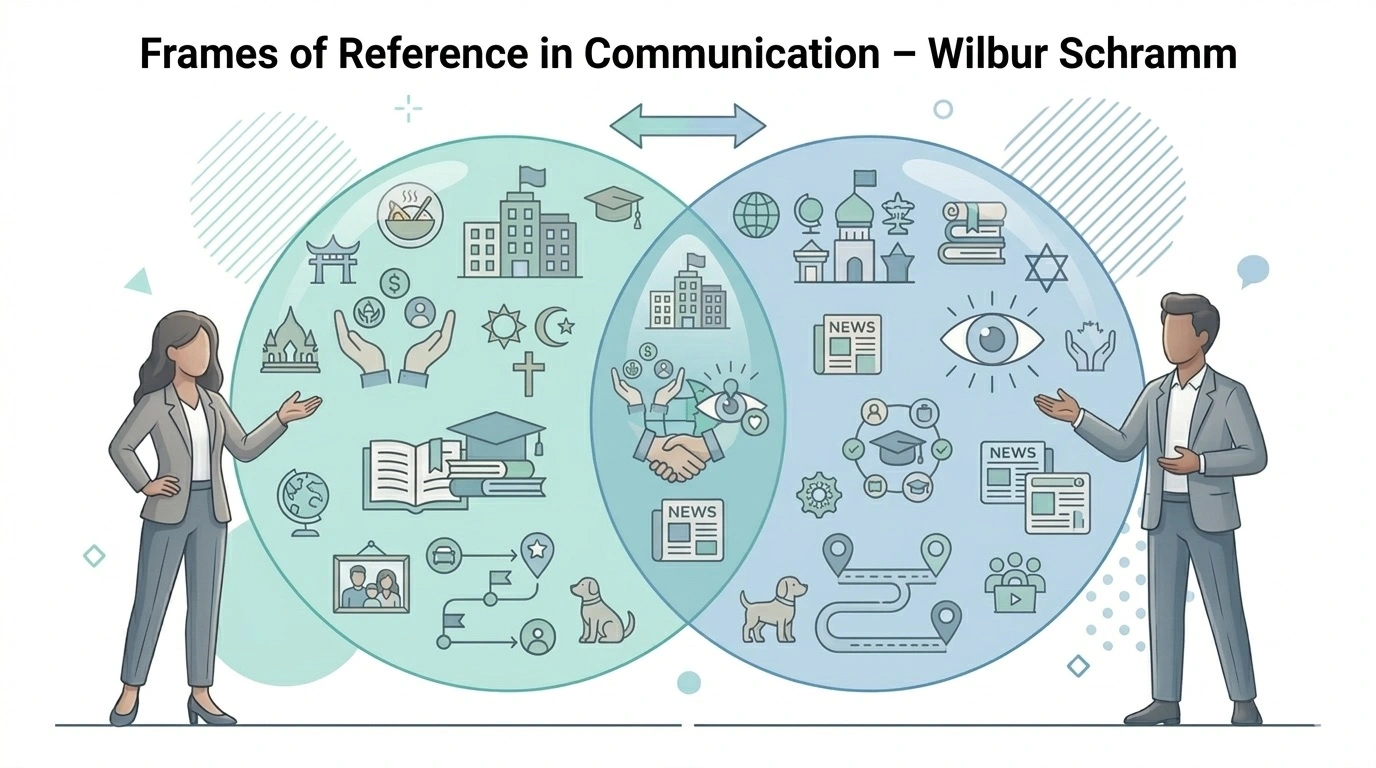
At the center of Schramm’s communication model lies the concept of Frames of Reference. Schramm defined a frame of reference as an individual’s “fund of usable experience.”
- This fund includes accumulated experiences, cultural knowledge, attitudes, beliefs, and social learning. These factors collectively shape how individuals perceive and interpret messages.
- In communication theory, frames of reference function as psychological filters. When individuals encounter a message, they interpret it using their existing knowledge and experiences.
- Schramm emphasized that meaning does not exist in the message itself. Instead, meaning is created within the minds of the participants. It is therefore both a cognitive and emotional response shaped by individual experiences.
- Effective communication requires a certain level of shared experience between the sender and receiver. When their frames of reference overlap significantly, the chances of mutual understanding increase.
- If the overlap is small, however, communication may lead to misunderstanding. Words, images, or symbols may produce different meanings for different audiences because they are interpreted through different experiences.
Components that Shape Frames of Reference
Frames of reference develop gradually through various social and psychological influences. Several key factors shape how individuals interpret communication messages.
Culture: Cultural learning plays a fundamental role in shaping meaning. Language, symbols, traditions, and shared values influence how people understand communication signs.
Personal Experiences: Individuals accumulate experiences that shape their interpretation of reality. These experiences influence how they associate communication symbols with specific events or objects.
Education: Educational background affects vocabulary, analytical abilities, and the capacity to understand abstract ideas. Differences in education often lead to differences in message interpretation.
Beliefs and Values: Existing beliefs and attitudes act as filters that influence how individuals process new information. Messages that support existing beliefs are more likely to be accepted, while contradictory information may be rejected.
Social Background: Social identities such as profession, class, religion, or political affiliation influence communication interpretation. These identities shape expectations and attitudes toward different messages.
Feedback and Noise in the Communication Process
Schramm’s model also incorporates two important variables that influence communication effectiveness.
Feedback: Feedback refers to the response that returns to the communicator from the receiver. It allows the sender to evaluate whether the message has been understood correctly. Feedback may be internal, such as hearing one’s own words while speaking, or external, such as observing the reactions of the audience. This feedback enables communicators to adjust their messages to improve understanding.
Noise: Noise refers to any interference that disrupts communication. This interference may occur in many forms, including physical distractions, technical problems, unclear language, or competing messages. Noise can distort meaning and reduce the effectiveness of communication.
The Process of Message Selection
Schramm also explained that audiences are active participants who selectively choose which messages to attend to. Because individuals are not passive receivers, they often ignore messages that appear irrelevant or require excessive effort to understand.
Schramm described this behavior through the concept of the “fraction of selection.” According to this principle, people are more likely to select messages when the perceived reward of the message is high and the effort required to understand it is low. This concept helps explain why media messages that are clear, relevant, and engaging are more likely to attract audience attention.
Examples in Media and Journalism
Research in communication studies provides several examples illustrating how frames of reference influence interpretation.
A simple example involves the word “dog.” A person who has grown up in Arctic regions and interacted primarily with sled dogs may imagine a very different animal compared to a city resident familiar with small domestic breeds. Although the sign “dog” is identical, the interpretation differs because of different experiences.
A more complex example appears in the “Mr. Bigot” experiment, which studied reactions to anti-prejudice cartoons. Researchers found that individuals with strong prejudiced attitudes interpreted the cartoons in ways that reinforced their existing beliefs rather than recognizing the intended criticism of prejudice.
Another famous example is the “They Saw a Game” study conducted by Albert Hastorf and Hadley Cantril during the 1951 Princeton–Dartmouth football game, later published in 1954. Students from Princeton and Dartmouth watched the same film of a controversial football game. Despite viewing identical footage, the two groups reported different numbers of rule violations because their school loyalties influenced their interpretation of events.
These studies demonstrate that audiences interpret media content through their own psychological and social frameworks.
Relevance in Modern Media Communication
Although the concept of frames of reference originated in early communication research, it remains highly relevant in the modern media environment.
- Today’s global communication networks connect audiences from diverse cultural and social backgrounds. However, differences in cultural experiences often create barriers to understanding.
- Mass media function as extensions of human perception, allowing individuals to form images of events they cannot directly experience. News reports, films, and digital media all shape the way people imagine distant realities.
- However, audiences interpret these media representations according to their own frames of reference. As a result, the same media message may generate different meanings among different cultural groups.
- Modern communication systems also illustrate the multi-step flow of communication, in which information reaches audiences through intermediaries such as opinion leaders or influencers. These intermediaries interpret messages according to their own social contexts and transmit them to others.
Thus, the ultimate impact of communication occurs at the level of the individual’s organized perception of reality.
Critical Analysis and Importance
The concept of frames of reference provides an important explanation for the complexity of communication effects. It demonstrates that audiences are not passive recipients of information but active participants in meaning construction.
This perspective helps explain why communication campaigns sometimes fail. Messages that differ too strongly from the audience’s beliefs or experiences may be rejected or misunderstood. The theory also shifts the focus of media research from what media do to people toward what people do with media messages. Individuals interpret, modify, and sometimes resist media content based on their psychological and social frameworks.
For this reason, the concept of frames of reference remains a foundational idea in the study of media effects, audience interpretation, and public opinion formation. Understanding this theory enables communicators, journalists, and media professionals to design messages that better connect with diverse audiences and promote effective communication.
Conclusion
- Frames of reference represent the experiences, beliefs, and cultural knowledge that shape message interpretation.
- Effective communication depends on the overlap of frames of reference between sender and receiver.
- Communication is a circular and interactive process, not a simple one-way transmission.
- Audience members actively interpret media messages based on their own experiences.
- The theory remains essential for understanding modern media communication and audience behavior.
References
- Schramm, W. (1971). The Process and Effects of Mass Communication. University of Illinois Press.
https://www.worldradiohistory.com/BOOKSHELF-ARH/Education/The-Process-and-Effects-of-Mass-Communications-Schramm-1971.pdf - Schramm, W. (1954). How Communication Works. In The Process and Effects of Mass Communication.
- Hastorf, A., & Cantril, H. (1954). They Saw a Game: A Case Study. Journal of Abnormal and Social Psychology.
- McQuail, D. (2010). McQuail’s Mass Communication Theory. Sage Publications.