




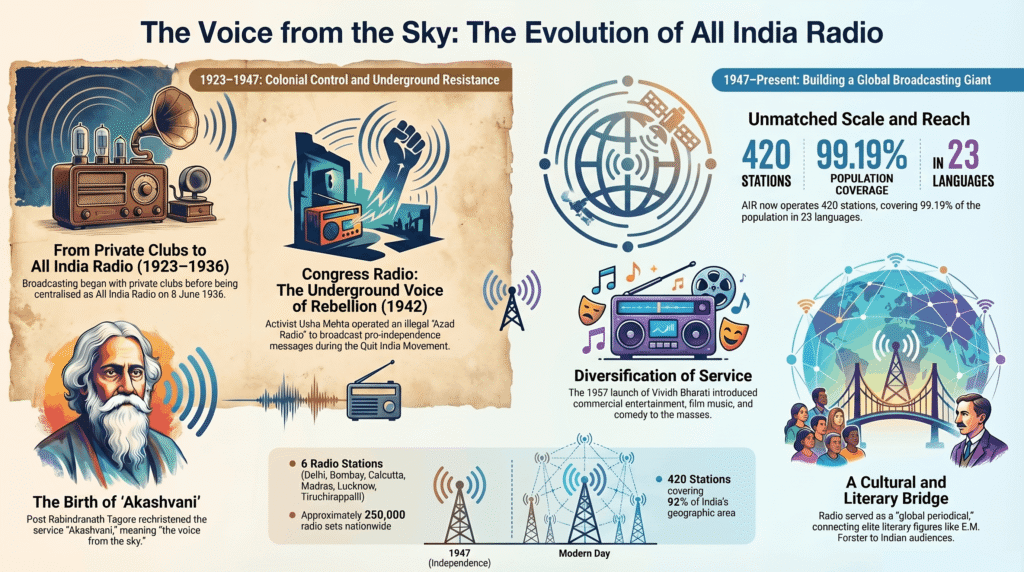
We are living in a world filled with constant digital noise and algorithm-driven content. In this environment, the idea of Akashvani—the “Voice from the Sky”—feels like something from another era. Today, All India Radio (AIR) stands as a massive achievement in media. It reaches 99.19% of the Indian population and broadcasts in 23 languages and 179 dialects.
However, if we look deeper, the story becomes more complex. The history of AIR is not a simple journey of progress. Instead, it is shaped by chaotic private ventures, strict state control, and the transformation of spoken communication. Over time, radio became a space where power, politics, and culture constantly interacted.
1. The “Office of Thugs” and the Art of Political Silence
In its early colonial iteration, the British Raj viewed radio as a state-controlled mouthpiece designed to exhaust the listener into submission through propaganda. Z.A. Bukhari, a pivotal figure in early Indian broadcasting, famously dubbed the British Intelligence Bureau the “Office of Thugs.” This bureau operated as a shadow editor, ensuring that the “public service” was, in fact, an exercise in political silence.
The tension between the Raj and Indian nationalism often manifested in the most granular details of programming. When the broadcaster Asif Ali was invited to speak on “The Delhi of Yore,” the Intelligence Bureau’s reactionary instincts were triggered simply because his name appeared in the radio magazine Awaaz. They demanded a vetting of his scripts, fearful of the “rebel” voice. This led to a desperate attempt to censor a historical retort involving Lord Curzon and the scholar Deputy Nazir Ahmad. The Raj sought an “aura of transparency” through the medium, yet they could not tolerate the truth of Ahmad’s cool reply to Curzon’s claim that Indians were liars:
“Indeed they are. And you are the King of liars.”
This paradox defines the era: a technology capable of revolutionary intimacy was being throttled by a colonial administration that viewed its subjects as a crowd to be managed rather than a public to be engaged.
2. The Midnight Rebellion of “Congress Radio”
While the BBC was projecting “soft power” from London, the Raj was simultaneously gagging the mainstream press in India. In response, a 22-year-old student activist named Usha Mehta organized a daring democratic alternative: “Congress Radio” (also known as Azad Radio). During the 1942 Quit India Movement, this underground station became the first true democratic alternative to state media.
The technical ingenuity required to evade the CID’s Special Branch was a masterclass in nomadic media. Mehta’s team moved their transmitter between secret apartments to mask their location, creating a spectral presence that the authorities could not pin down. When a raid in Nashik became imminent, the operators demonstrated a final act of technical defiance: they immersed their equipment in the Godavari river at the Shankaracharya math. This “illegal” broadcast was vital precisely because it provided facts when the state provided only silence. The station operated from several key Bombay locations:
- Sea View building (Chowpatty)
- Ajit Villa (Laburnum Road)
- Paradise bungalow (Near Mahalakshmi temple)
3. An Unlikely Writers’ Room: The Literary Front
There is a profound irony in the fact that while 22-year-old students were being arrested for broadcasting in India, the BBC’s Eastern Service in London was transforming into a high-speed, nearly global periodical. This “Literary Front” employed intellectual giants like George Orwell, E.M. Forster, and Mulk Raj Anand.
The strategic logic was a cynical but brilliant application of soft power: the BBC used “anti-British” voices to establish intellectual credibility. They understood that the “native elite” and university students would find Nazi or Japanese propaganda crude in comparison to the sophisticated literary talks beamed from London.
These broadcasts were often unavailable to British citizens, creating a strange “intermediality” where the cutting edge of English criticism existed primarily in the shortwave skip distances between London and the subcontinent.
The Literary Airwaves
| Author | Radio Role/Contribution | Significance |
| George Orwell | Assistant to the Program Organizer | Used “highbrow” cultural commentary to counter fascist disinformation. |
| E.M. Forster | Host of Some Books program | Created an “on-air periodical” that reviewed literature faster than any print medium. |
| Mulk Raj Anand | Broadcaster and scriptwriter | Negotiated the aesthetic of “speed” and topicality within the colonial machine. |
4. Technical Surrealism: Boozy Studios and Circular Clocks
The early days of private radio in Bombay and Calcutta were characterized by a technical naivety that bordered on the surreal. Entrepreneurs installed weak “one-kilowatt” transmitters, genuinely—and mockably—believing these tiny pulses could cover the entire breadth of the Indian subcontinent.
The studios themselves were “acoustically deadened” sanctuaries where the Raj attempted to manufacture a “natural” voice. Central to this was the ribbon microphone. Sonically self-effacing and possessing a flat response, the ribbon mic was visually iconic but served a specific ideological purpose: it created a sense of secondary orality that felt intimate and unmediated, even as the “Office of Thugs” stood by with the censor key.
In Bombay, the environment was less clinical. The station director was known for his fondness for alcohol and “nautch girls,” frequently giving airtime to the favorites of local tycoons. This collision of modern technology and localized, informal colonial administration led to the famous “circular clock” anecdote recounted by Lionel Fielden:
- The Radio station matched its time to the Posts Department.
- The Posts Department matched its time to the Railways.
- The Railways, in turn, matched their time to the Radio station.
5. The “Umbilical Cord” of the Exile: Radio and James Joyce
Perhaps the most profound example of radio’s role in modernism is James Joyce’s obsession with the medium. Living in Paris, Joyce viewed the radio as his “umbilical cord” to Ireland. He famously rigged a walking-stick antenna on his balcony just to catch the faint signals of his son singing across the Atlantic.
This experience of shortwave static and wandering signals fundamentally shaped the “polylogue” style of Finnegans Wake. Joyce saw the radio not just as a box of wires, but as a “tolvtubular high fidelity daildialler” capable of collapsing the distance between the exiled artist and the domestic presence of home.
The book’s cacophony of overlapping voices is a remediation of the shortwave experience, where the disembodied voice creates an intimacy that transcends the physical. As Joyce noted regarding his son’s voice:
“…we heard him singing across the ocean as clearly as if he had been in the next room.”
Conclusion: The Echo of the Sky
All India Radio’s legacy is a testament to the power of the voice to start a revolution and the power of the state to attempt to stifle it. It began in the boozy, chaotic studios of entrepreneurs and the censored halls of the Raj, yet it evolved into a vital link between the Indian experience and the global literary consciousness.
In an age of infinite digital noise, what can we learn from a time when a single “Voice from the Sky” was enough to start a revolution?