
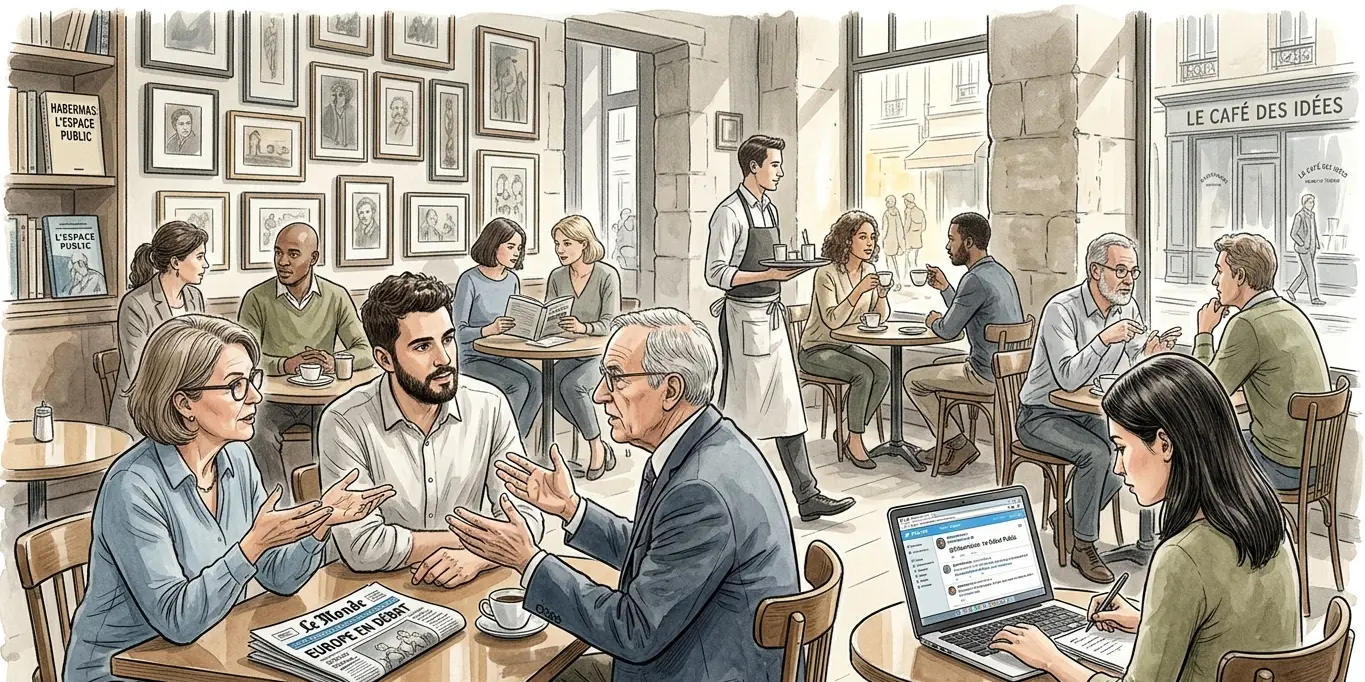
The concept of the public sphere plays a central role in understanding communication and democracy. Political parties, interest groups, and media institutions create messages that inform and influence citizens. These interactions shape how people understand power and governance.
The idea of the public sphere emerges from this process. It refers to a space where individuals come together as a public body. Within this space, people exchange ideas, form opinions, and engage in discussion. It connects society with the state and allows citizens to question authority and participate in democratic life.
Meaning and Definition
The public sphere refers to a part of social life where people form public opinion. It can be understood as a space where individuals discuss issues that concern everyone.
This space is not limited to physical locations. It also functions as a network where information and viewpoints circulate. Through continuous exchange, ideas are shaped into shared understanding. Participants act as citizens rather than private individuals. The focus shifts from personal interests to common concerns. This gives the public sphere its collective character.
Jürgen Habermas and the Public Sphere
The modern interpretation of this concept is closely linked to Jürgen Habermas. In The Structural Transformation of the Public Sphere (1962), he examined how public discussion evolved in early modern Europe.
He described the ‘bourgeois public sphere,’ where citizens debated public issues and influenced authority. His framework presents an ideal model of democratic communication. It shows how open discussion can support legitimate governance, even if real societies do not fully match this ideal.
Characteristics of the Public Sphere
It depends on a few essential conditions.
- Access remains fundamental. Citizens need information about public affairs so they can participate meaningfully.
- Discussion relies on reasoning. Arguments gain value through logic and evidence, not social position.
- Participation must remain open. Every individual should have the opportunity to express views without exclusion.
- Freedom also defines this space. People must speak and assemble without fear. These conditions depend on civil liberties such as freedom of expression and association.
Historical Development
The public sphere has evolved with social and technological change.
- In ancient Greek city-states, public discussion took place in open spaces like the agora. Citizens directly engaged in political matters.
- Later, in European monarchies, public life took a different form. It often reflected displays of royal authority rather than citizen participation.
- A shift became visible in the 18th century. As feudal structures weakened, new spaces for discussion appeared. Coffee houses in England, salons in France, and discussion groups in Germany encouraged debate on literature and politics.
- Newspapers expanded this development further. People in different locations could now engage with public issues. Public discussion gradually moved beyond physical spaces.
Role of Media in the Public Sphere
The media serves as the primary ‘communication infrastructure’ of the public sphere. It mediates between citizens and government institutions, acting as both a ‘mirror’ and a ‘moulder’ of public opinion. The media facilitates the public sphere by:
- Acting as a ‘Mind Manager’: The media has a significant bearing on the ideological mindset of the public. For a public sphere to exist, a two-way flow of communication is essential; the media must not only publish government information but also listen to and reflect the voices of the people.
- Setting the Agenda: Media outlets tell people ‘what to think about,’ influencing attitudes toward political issues and campaigns.
- Providing a Forum: It acts as a site for political encounters and encounters between the government and the governed.
Criticism of Public Sphere Theory
The theory has faced several criticisms.
- Early forms of this concept excluded large sections of society. Women, working-class groups, and minorities often remained outside these discussions.
- Media transformation has raised further concerns. Commercial pressures have changed how information is produced and presented. Public debate sometimes gives way to persuasion and profit-driven content.
- Some scholars argue that society does not have a single unified public sphere. Instead, multiple ‘counter-publics’ exist where different groups express their views.
- These critiques highlight the gap between theory and practice.
Contemporary Public Sphere
In the modern era, it has transitioned from physical locations to a communication network dominated by digital media. The ‘virtual public sphere’ of the internet and Social Networking Sites (SNS) has empowered individuals who were previously passive consumers of information.
- Engagement: Digital tools like Twitter and Facebook are used by politicians and citizens alike for direct mobilization and access to leadership.
- Challenges: The contemporary digital sphere faces issues of ‘digital divide’ (inequality of access), information fragmentation, and the spread of partisan or fake content. Despite these challenges, social media is seen as a tool for reviving democratic participation, as evidenced by its use in fighting corruption and organizing political protests.
Importance in Democracy
It remains essential for democratic systems.
- It allows citizens to question authority and hold leaders accountable. Without such a space, participation becomes limited.
- It also supports informed decision-making. Access to information and discussion improves understanding of public issues.
- Democratic governance depends on this process. Authority gains legitimacy when it reflects public opinion.
Conclusion
This concept continues to shape the relationship between communication and democracy. Its form has changed, yet its purpose remains consistent. From physical meeting spaces to digital networks, it has adapted to changing conditions. Its strength depends on openness, participation, and critical discussion. Future democratic systems will rely on how effectively these principles are maintained in evolving communication environments.
References
- Media Studies 101. (n.d.). Habermas’ public sphere (Part two: Culture and contexts, Section 17).
- The World Bank. (n.d.). The public sphere (CommGAP).
- Indira Gandhi National Open University. (n.d.). Media and the public sphere.