Before the 19th century, communication was painfully slow. Letters often took weeks or months to reach their destination. Business, governance, and personal life suffered from these delays. The invention of the telegraph changed everything. For the first time, people could send information instantly across great distances. The telegraph marked the beginning of modern communication.
Early Attempts Before the Telegraph
Humans have always searched for ways to talk across distances. Ancient societies used smoke signals, drums, or messengers. In the 1790s, Claude Chappe introduced an optical semaphore system in France. This method worked with mechanical arms on towers that relayed signals.
These systems were clever but limited. They required good weather, clear visibility, and short ranges. The arrival of the electric telegraph solved these problems.
Source: Briggs & Burke, A Social History of the Media (2010).
The Invention of the Telegraph
The telegraph’s story belongs mainly to Samuel Morse in the United States. In 1837, he built an electric telegraph system. By 1844, he sent the first official message from Washington to Baltimore: “What hath God wrought!”
In Britain, William Cooke and Charles Wheatstone also built a telegraph in the 1830s. Their system was advanced but costly. Morse’s version was simpler and cheaper, which made it popular worldwide.
Source: Winston, Media Technology and Society (1998).
Morse Code: A New Language
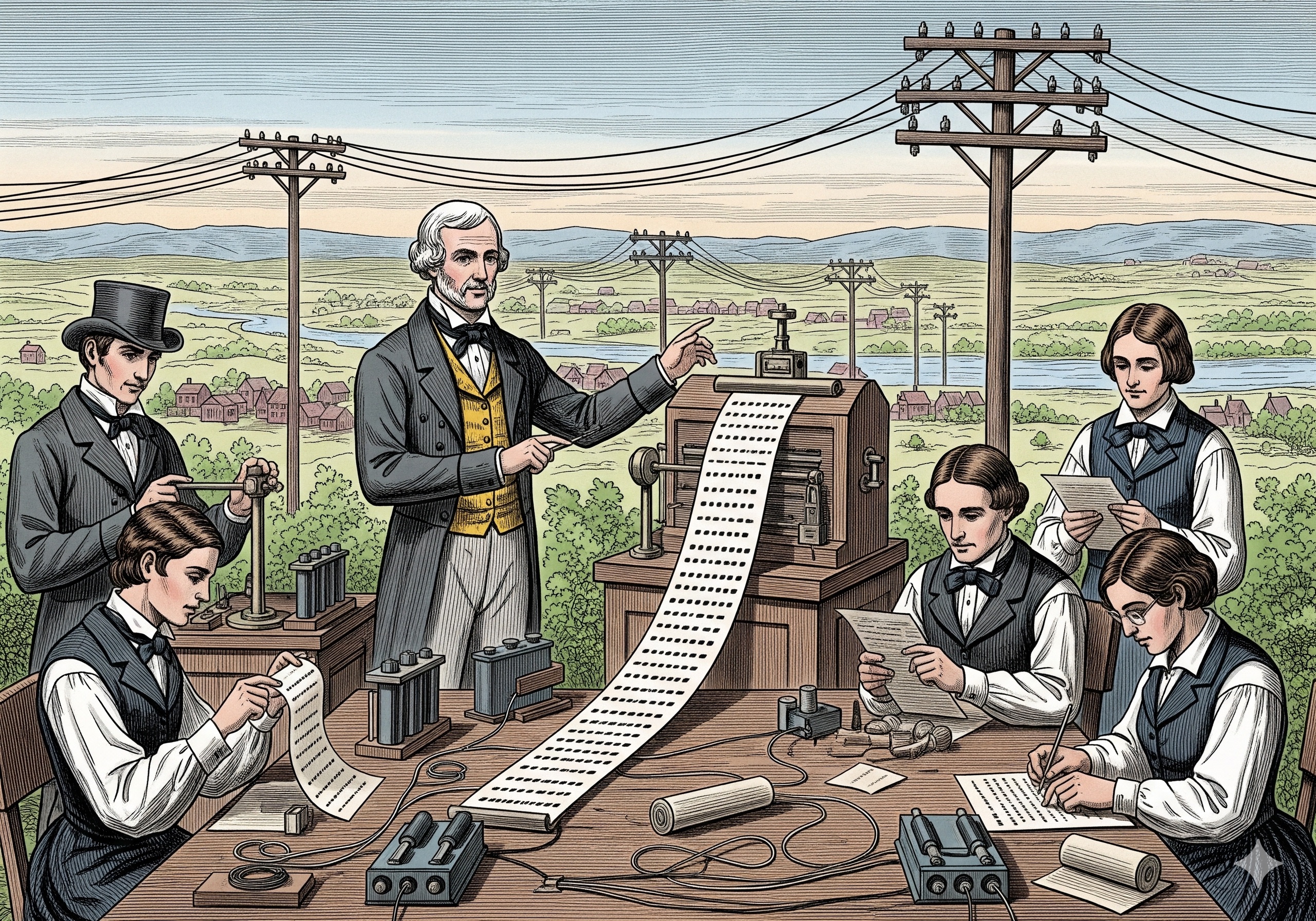
Morse also created a system to send messages—Morse Code. It used short and long signals, known as dots (·) and dashes (–), to represent letters and numbers.
Operators pressed a telegraph key to send these codes. At the receiving end, another operator decoded them into words. It required training, but it made communication fast and reliable.
Source: Standage, The Victorian Internet (1998).
The Telegraph in India
India saw its first telegraph experiment in 1851, with a line between Calcutta and Diamond Harbour. By 1857, during the Revolt, the British used the telegraph to send military orders quickly.
Over time, a large network spread across the country. For the British, the telegraph became a tool of administration and control, helping them manage a vast empire.
Source: Headrick, The Invisible Weapon (1991).
Impact of the Telegraph
Journalism and News
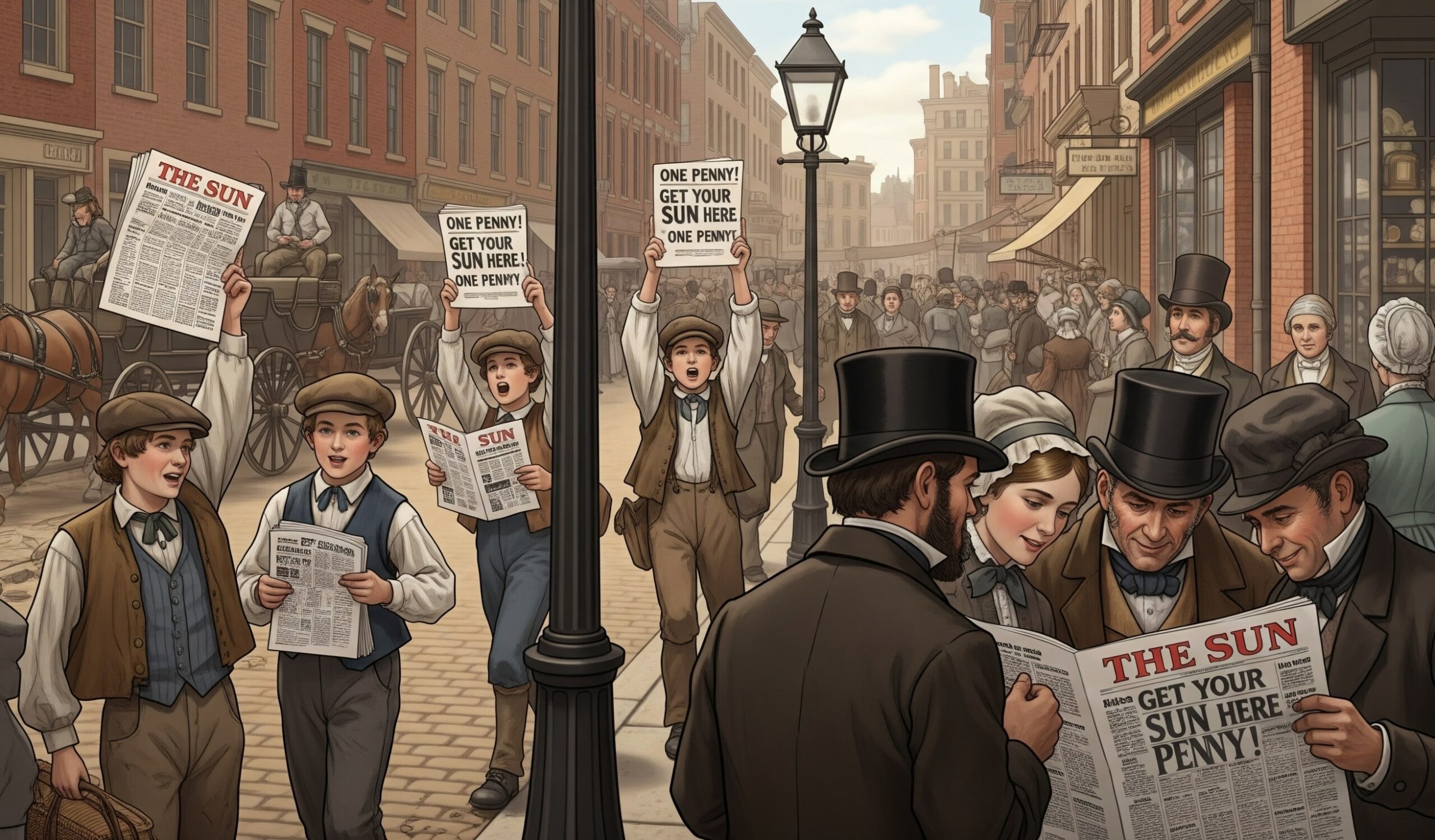
The telegraph transformed journalism. The Associated Press, founded in 1846, used it to send news instantly. For the first time, readers could access same-day news.
Business and Trade
Markets became faster. Stock prices, deals, and banking information travelled within minutes. Business efficiency increased dramatically.
Politics and Governance
Governments quickly saw the telegraph’s value. During the American Civil War (1861–65), President Abraham Lincoln sent orders to generals using the telegraph. Decision-making became quicker and more effective.
Globalization
In 1866, the first successful transatlantic cable connected Europe and America. Messages that once took weeks by ship now moved in minutes. This was the start of a global village, a term later popularised by Marshall McLuhan.
Sources: Standage (1998); Winston (1998).
Telegraph and Colonialism
Empires also benefited from the telegraph. The British built the “All Red Line,” a global telegraph network connecting their colonies. This system gave them speed and authority, making empire control stronger.
Social and Cultural Impact
The telegraph did not only serve governments and businesses. Families could send personal news faster than ever before. Society developed a new culture of urgency and immediacy.
Historian Tom Standage even called the telegraph the “Victorian Internet” because its impact on daily life was similar to how the internet shapes our world today.
Limitations of the Telegraph
Despite its success, the telegraph had some weaknesses:
- It required skilled operators trained in Morse Code.
- It could only send text, not voice or images.
- Undersea cables were costly and often fragile.
Even so, no other system of its time could match its speed.
Legacy and Future Inventions
The telegraph created the base for modern telecommunications. The telephone (1876) and radio (1895) developed directly from telegraph technology. Even today’s internet works on the same principle: sending coded signals across networks.
Conclusion
The invention of the telegraph was more than a machine. It was a revolution. It broke barriers of distance and time, reshaped journalism, made business faster, strengthened governments, and linked continents. In India, it supported colonial rule. Globally, it created the first steps toward a connected world.
For students of media history, the telegraph is essential. It was truly the Internet of the 19th century.