
Introduction
Imagine a time when newspapers were a luxury. In the early 19th century, only wealthy elites could afford them. Then came a revolutionary idea—make newspapers cheap enough for the common people. This was the birth of the Penny Press in America during the 1830s.
History of the Penny Press
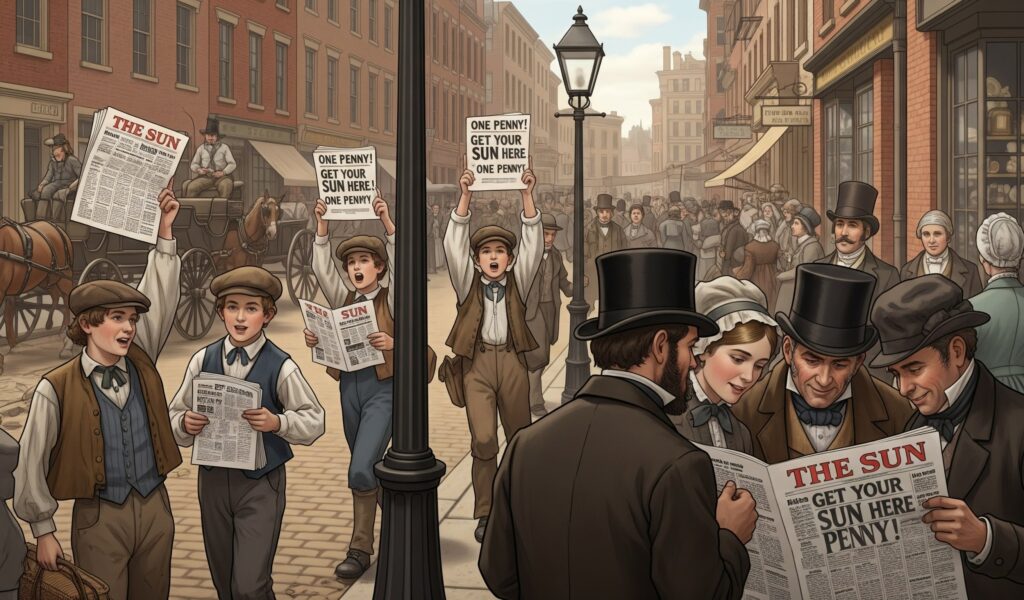
In 1833, Benjamin Day, a young journalist in New York, launched The Sun. Unlike existing newspapers that cost six cents, The Sun sold for only one penny. Before this, newspapers were expensive and targeted businessmen, politicians, and intellectuals. They focused on political debates, commerce, and government updates. Ordinary citizens often found them irrelevant and unaffordable.
The Penny Press broke this barrier. It was cheap, entertaining, and accessible. For the first time, newspapers reached a mass audience, not just the elite.
Source: Michael Schudson, Discovering the News: A Social History of American Newspapers (1978).
Features of the Penny Press
The Penny Press became popular because of its unique features.
- Low price: Just one penny, making it affordable for everyone.
- Simple language: Easy-to-read style, understandable to ordinary people.
- Popular content: Stories of crime, entertainment, human interest, and local events.
- Wide distribution: Sold on the streets by hawkers, not just through subscriptions.
- Advertising model: Revenue came mainly from advertisements instead of costly subscriptions.
These features made newspapers a part of everyday life.
Source: James L. Crouthamel, Bennett’s New York Herald and the Penny Press (1989).
Media Impact of the Penny Press
The Penny Press had a huge impact on journalism and media.
- Mass audience: For the first time, newspapers targeted ordinary people, not just elites.
- Commercial journalism: Newspapers became a profitable business through advertisements and high circulation.
- Shift in content: Focus moved from politics and business to issues that mattered to common readers.
- Birth of modern journalism: News became faster, more entertaining, and more democratic.
This transformation changed the relationship between media and society forever.
Source: Gerald J. Baldasty, The Commercialization of News in the Nineteenth Century (1992).
Conclusion
The Penny Press marked a turning point in media history. By lowering prices, simplifying content, and focusing on everyday stories, it brought journalism to the masses. It showed that newspapers could both serve the public and run as a successful business.
For students of media, the Penny Press is not just history—it is the origin of modern journalism as we know it today.