
mass communication models

Illustration explaining Wilbur Schramm’s Frames of Reference in communication showing shared experience between sender and receiver

Wilbur Schramm’s Field of Experience (Frame of Reference) in Communication: Theory, Model, Examples, and Media Relevance
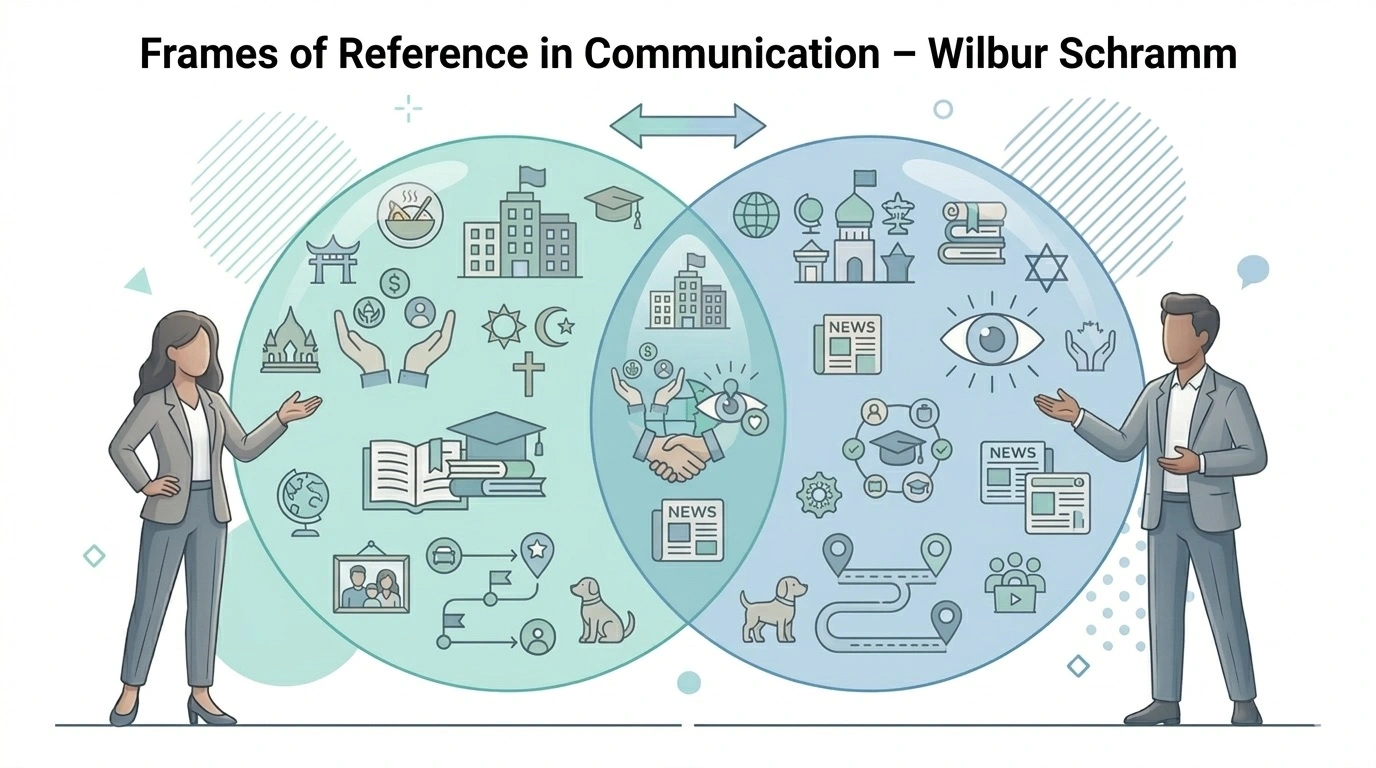
In the field of mass communication studies, theoretical models have gradually evolved from simple linear explanations to more complex understandings of human interaction. Early theories often portrayed audiences as passive recipients of media messages. One of the most prominent examples was the Bullet Theory, also known as the Hypodermic Needle Model, which suggested that media […]

Wilbur Schramm’s Field of Experience (Frame of Reference) in Communication: Theory, Model, Examples, and Media Relevance Read More »

In Jakobson’s model, the constitutive factors in an act of number is: 

In Jakobson’s model, the constitutive factors in an act of communication number is:  (A) three (B) four (C) five (D) six Correct Ans: (D) Explanation:Roman Jakobson’s model outlines six constitutive factors involved in any act of communication. His framework goes beyond a simple sender-receiver model by integrating linguistic and contextual elements. These six components are:

In Jakobson’s model, the constitutive factors in an act of number is:  Read More »

Two-step flow of communication argues that

Two-step flow of communication argues that(A) People are not isolates(B) People live without communication(C) People-mass media nexus(D) People are not the subjects in communication Correct Ans: (A) Explanation: The two-step flow of communication theory, introduced by Paul Lazarsfeld and Elihu Katz, highlights a very important aspect of how people process media messages. According to this

Two-step flow of communication argues that Read More »

Matching Mass Communication Models with Theorists

Match List – I with List – II: List I- (Model) List II- (Theorist) (a) Model of Mass Communication process 1. Comstock (b) Cognitive Dissonance Theory 2. Ball-Rokeach & Defleur (c) Dependency Model of Mass Communication 3. Festinger (d) Psychological model of television effect 4. Maletzke Codes: (a) (b) (c) (d) (A) 2 3 4

Matching Mass Communication Models with Theorists Read More »

Scroll to Top