About Course
Prepare with Clarity. Learn with Structure. Approach CUET UG with Confidence.
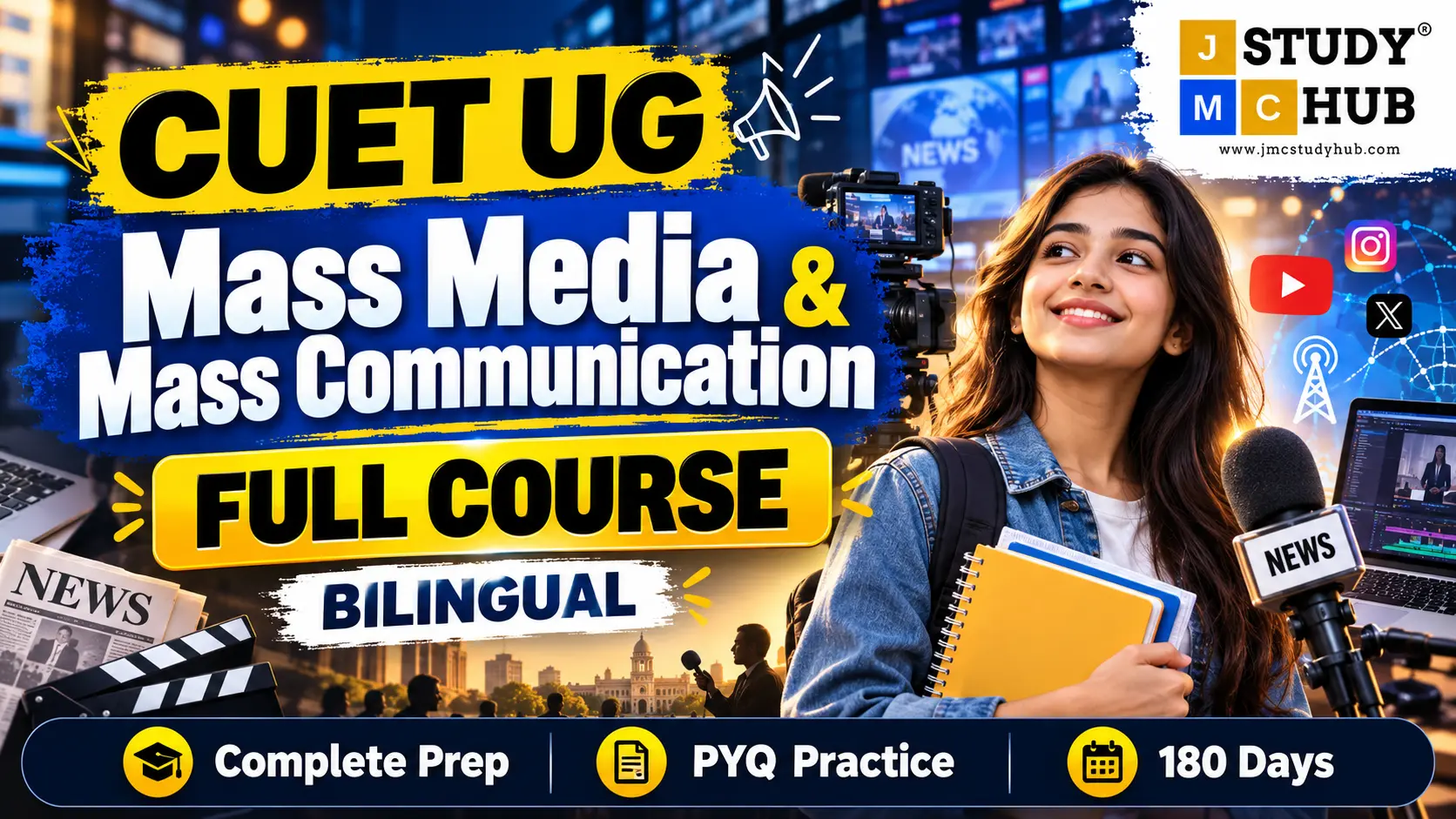
If you are preparing for CUET UG Mass Media / Mass Communication and want one organised course that takes you from concepts to practice, this bilingual Full Course is designed to give your preparation a clear direction.
The course provides detailed, beginner-friendly coverage of the complete syllabus, including Communication, Journalism, Advertising, Television Production, Radio, Cinema, Social Media and New Media. Syllabus_CUET_UG_Mass Comm Syllabus_CUET_UG_Mass Comm Syllabus_CUET_UG_Mass Comm
You learn through Video Lectures, Study Materials, Practice Quizzes, integrated PYQs and Quick Revision Notes, so preparation does not remain limited to passive reading or watching.
A Structured Learning Path
The course is designed especially for learners who may be new to Mass Communication and need concepts explained clearly before moving toward exam preparation.
The learning flow is simple:
Understand → Practise → Revise → Improve
A dedicated exam-strategy lesson helps you approach preparation more intelligently, while regular quizzes and PYQ-based practice help you check understanding and become more familiar with the type of thinking required for the exam.
Everything Organised in One Place
On the JMC Study Hub platform, you can save notes, track course progress, review detailed quiz reports, access learning resources, and post doubts or queries through your learning dashboard.
Instead of depending on scattered resources, you get one structured learning environment for studying, practising and revising.
With 180-day access, the course gives you enough flexibility to learn at your own pace and revisit important topics whenever needed.
Whether you are beginning your preparation from scratch or looking for a more organised way to prepare, this course helps you build stronger concepts and approach CUET UG with greater confidence.
Learn clearly. Practise regularly. Prepare with confidence.
What Will You Learn?
- Core Media Concepts
- Complete Syllabus Clarity
- Exam Strategy
- PYQ Practice
- Revision Confidence
Course Content
Introduction
-
Introduction of the Course
-
Overview of the Syllabus
05:31
Unit 1: Communication
-
10:25
-
Communication: Origin, Meaning, Definitions and Basic Elements
-
08:24
-
Culture and Communication
-
07:57
-
Media as a Vehicle of Cultural Transmission
-
Representation and Stereotyping in Mass Media
07:46 -
Representation and Stereotyping in Mass Media
-
Communication in the Cultural Context
10:14 -
Communication in the Cultural Context
-
Communication and Social Change
13:03 -
Communication and Social Change
Unit 2: Mass Media
-
History of Newspapers in India
09:46 -
History of Newspapers in India
-
History of Radio in India
10:49 -
History of Radio in India
-
History of Television in India
07:13 -
History of Television in India
-
History and Rise of New Media
05:58 -
History and Rise of New Media
-
Parallel Cinema and Social Change
06:31 -
Parallel Cinema and Social Change
-
Case Study: Mass Media and Social Movements in India
06:25 -
Mass Media and Social Movements in India
Unit 3: Journalism
-
Qualities of a Good Journalist
08:36 -
Qualities and Skills of a Competent Journalist
-
Sensationalism and Fake News
06:03 -
Sensationalism and Fake News
-
Paid News and Advertorials
05:30 -
Paid News and Advertorials
-
Plagiarism and Partisan Reporting
06:54 -
Plagiarism and Partisan Reporting
-
Sting Operations and Defamation
06:54 -
Sting Operations and Defamation
-
Freedom of Speech and Expression in Journalism
09:00 -
Freedom of Speech and Expression in Journalism
Unit 4: Advertising and TV Production
-
Advertising Concepts and Process
06:40 -
Advertising: Core Concepts, Strategy, and Campaign Planning
-
Functions and Types of Advertising
06:39 -
Functions and Types of Advertising
-
Forms of Advertising (Cross Promotions, Merchandise, Covert)
05:23 -
Cross-Promotion, Merchandise, and Covert Advertising
-
Pre-Production Stage in Television
06:29 -
Pre-Production in Television Production
-
Production and Post-Production Stages
07:08 -
Production and Post-Production in Television
-
Understanding Television as a Communication Medium
07:20 -
Television as a Communication Medium
Unit 5: Radio
-
Characteristics of Radio Scripts
04:41 -
Characteristics of Radio Scripts
-
Writing for Radio (Conversational, Simple, Visual Language)
06:01 -
Writing for Radio: Conversational Style, Simplicity, and Visual Language
-
Radio Studio Equipment (Microphones, Amplifiers, Mixers)
07:00 -
Radio Studio Equipment and the Broadcast Chain
-
Audio Recording and Transmission Basics
06:20 -
Sound, Recording, and Radio Transmission
-
Imagery in Radio Communication
05:27 -
Imagery in Radio Communication
-
Role of Radio in Mass Communication
05:27 -
Radio as a Medium of Mass Communication
Unit 6: Cinema
-
History of Cinema (Lumiere, Grierson, Flaherty, Phalke)
04:35 -
Pioneers of Cinema: Lumiere, Phalke, Flaherty, and Grierson
-
Cinema Genres (Action, Comedy, Drama, etc)
06:07 -
Cinema Genres: Conventions, Forms, and Hybridity
-
Genre Theory and Film Analysis
05:01 -
Genre Theory and Film Analysis
-
Social Issues in Indian Cinema
07:48 -
Indian Cinema and Society: Representation and Social Change
-
Parallel Cinema Movement
06:09 -
The Parallel Cinema Movement: Indian New Wave
-
Cinema as a Medium for Social Change
06:33 -
Cinema as a Medium for Social Change
Unit 7: Social Media
-
Definition and Types of Social Media
04:14 -
Social Media: Definition, Characteristics, and Types
-
Role of Social Media in Democracy
06:14 -
Role of Social Media in Democracy
-
Creating Collective Identities Online
05:06 -
Online Collective Identity and Virtual Communities
-
Cyber Activism
05:31 -
Cyber Activism: Digital Activism and Internet Activism
-
Cyber Crimes – Trolling, Bullying, Online Frauds
06:05 -
Cyber Crimes – Trolling, Bullying, Online Frauds
-
Netiquettes and Digital Behavior
04:55 -
Netiquette: Responsible Communication in Digital Spaces
Unit 8: New Media
-
Internet as the Hub of All Media
05:09 -
The Internet as a Hub of Media Convergence
-
Broadcasting and Mass Communication Models
09:19 -
Communication Models: Transmission, Interaction, Transaction, and Ritual
-
Media Organizations and Revenue Models
09:02 -
Media Economics: Ownership, Revenue Models, and Editorial Independence
-
Individual Empowerment in Digital Media
05:12 -
Individual Empowerment in Digital Media
-
Cross-Media Integration and Information Flow
06:56 -
Cross-Media Integration and Information Flow
-
New Media’s Impact on Society and Democracy
06:45 -
New Media’s Impact on Society and Democracy
Student Ratings & Reviews
