
audience interpretation

Illustration explaining Wilbur Schramm’s Frames of Reference in communication showing shared experience between sender and receiver

Wilbur Schramm’s Field of Experience (Frame of Reference) in Communication: Theory, Model, Examples, and Media Relevance
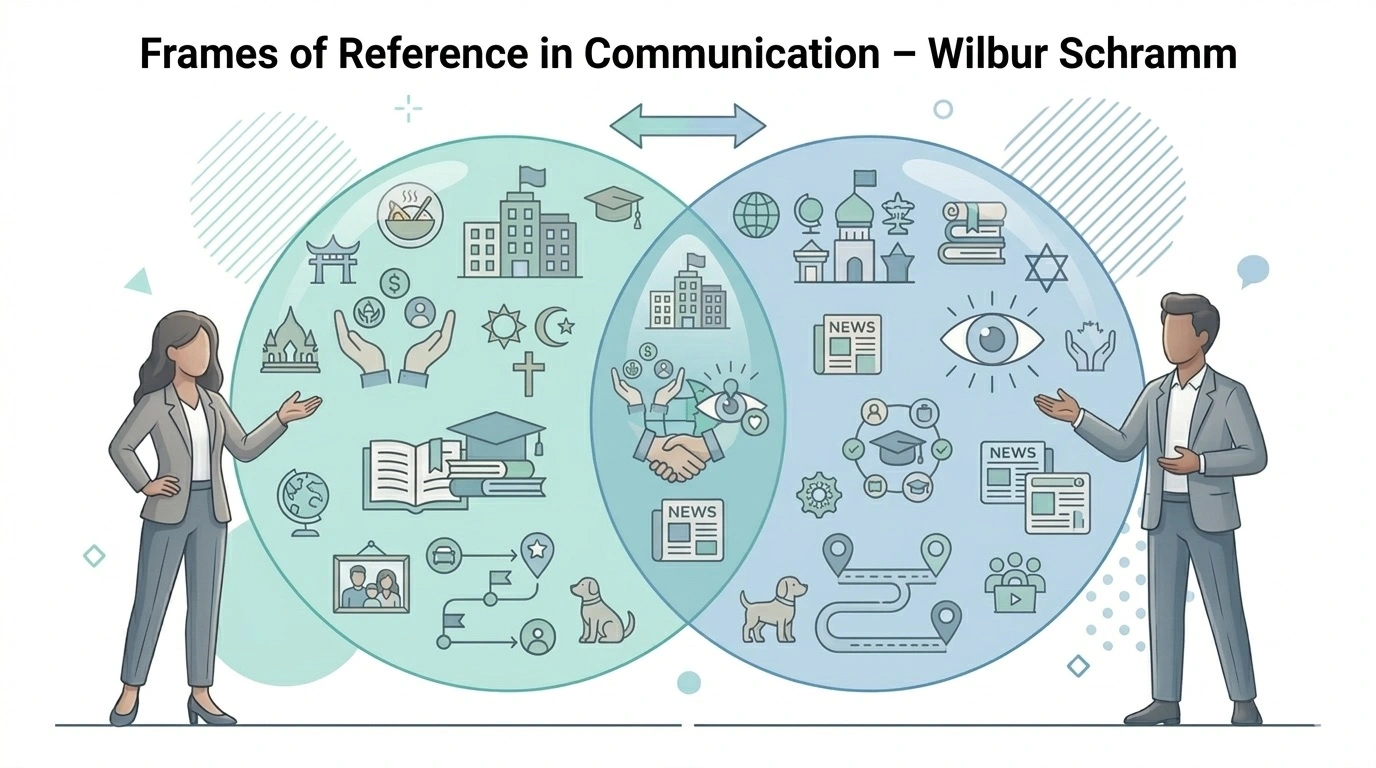
In the field of mass communication studies, theoretical models have gradually evolved from simple linear explanations to more complex understandings of human interaction. Early theories often portrayed audiences as passive recipients of media messages. One of the most prominent examples was the Bullet Theory, also known as the Hypodermic Needle Model, which suggested that media […]

Wilbur Schramm’s Field of Experience (Frame of Reference) in Communication: Theory, Model, Examples, and Media Relevance Read More »

pleasure results from particular relationship between meanings and

 In communication, pleasure results from a particular relationship between meanings and _______. (A) contentions (B) power (C) manipulation (D) isolation Correct Ans: (B) Explanation:In communication, pleasure often emerges from how audiences interpret meanings in relation to power structures. Meaning is not produced in a vacuum. Instead, it interacts with power—social, cultural, political, or economic—to shape

pleasure results from particular relationship between meanings and Read More »

Different readings of audience derived from different sub-cultural 

The different readings of the audience derived from different sub-cultural experiences are called:  Correct Ans: (C) Explanation: Aberrant decoding refers to a phenomenon in media and communication studies where audiences interpret a media message in a way that differs significantly from the intended meaning of the sender. This divergence typically results from varied sub-cultural, social,

Different readings of audience derived from different sub-cultural  Read More »

Generally, referential readings are

Generally, referential readings are (A) Normal (B) Researched (C) Emotional (D) Prohibitive  Correct Ans: (C) Explanation: Referential readings primarily engage with emotions, influencing how audiences interpret messages. Unlike analytical or critical readings, these interpretations focus on personal experiences, memories, and feelings rather than objective analysis. People often connect with media content based on their emotions,

Generally, referential readings are Read More »

Scroll to Top