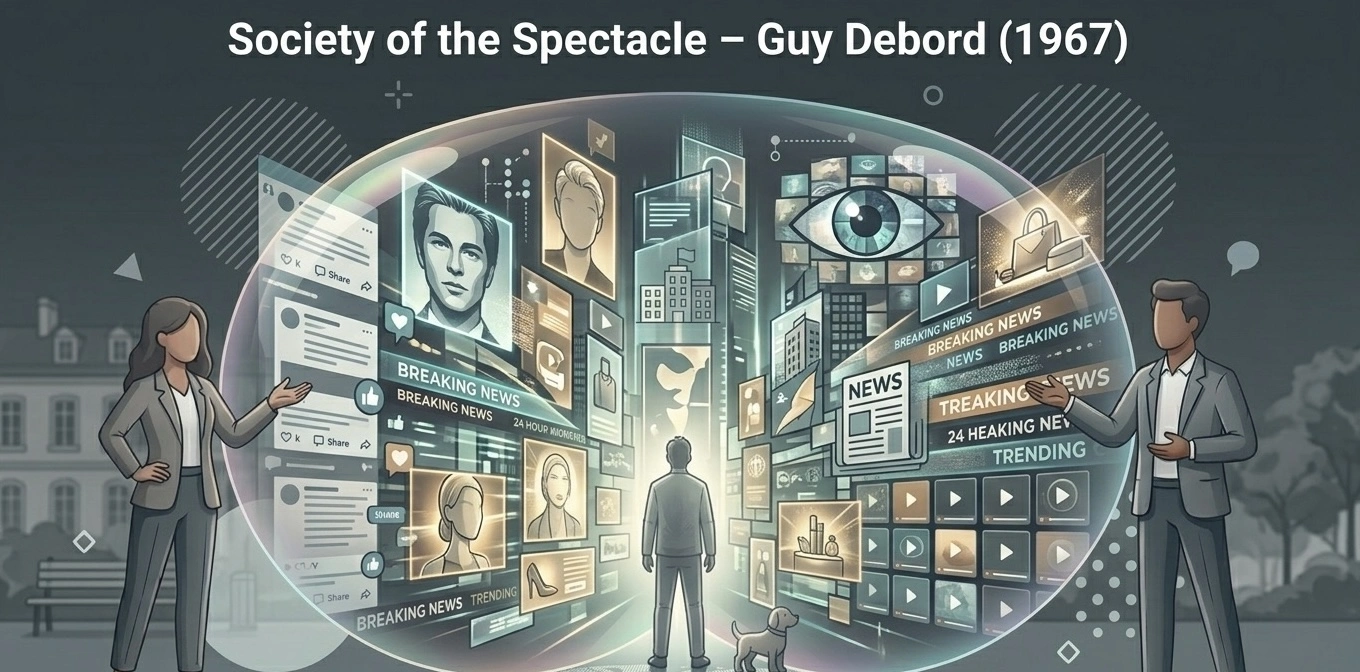
The concept of the Society of the Spectacle, introduced by French theorist Guy Debord in 1967, offers one of the most influential critiques of modern capitalist society and media culture. Debord argued that modern life increasingly revolves around images, representations, and mediated experiences rather than direct reality. In this system, social relationships are no longer built primarily through lived experiences but through representations produced and circulated by media and consumer culture.
Debord famously defined the spectacle as “a social relation among people, mediated by images.” This definition emphasizes that the spectacle is not merely a collection of visual images such as advertisements, television programs, or digital media content. Rather, it represents a broader social condition in which appearances dominate reality and consumption replaces genuine human experience.
The theory is particularly relevant for understanding modern media environments, where individuals constantly encounter images that shape their perceptions of identity, success, and social reality. By examining the spectacle, Debord highlights how modern societies often prioritize perception over truth and representation over authentic existence.
Scholar and Intellectual Background
Guy Debord (1931–1994) was a French Marxist theorist, filmmaker, and writer who played a central role in radical intellectual and artistic movements in twentieth-century Europe. He was associated with the Lettrist International and later became a founding member of the Situationist International, a revolutionary artistic and political movement formally established in 1957.
Debord developed the concept of the spectacle within the historical context of post-World War II Europe, a period characterized by rapid economic expansion, technological development, and the growth of mass consumer culture. During this period, capitalist societies experienced a transformation in which consumption, advertising, and media imagery increasingly shaped everyday life.
Debord’s theoretical approach was influenced by several philosophical traditions. His work draws heavily from Karl Marx’s critique of capitalism, particularly the idea of commodity fetishism, which explains how social relationships become expressed through commodities. At the same time, Debord engaged with the philosophical tradition of Georg Wilhelm Friedrich Hegel, whose dialectical approach emphasized the dynamic interaction between ideas, historical development, and material conditions.
By combining these intellectual influences, Debord argued that modern capitalism had reached a stage where economic power and media representation had merged, producing a society in which social reality is continuously reproduced through images and commodities.
Meaning of the Society of the Spectacle
For Debord, the spectacle represents a historical stage in which modern production transforms everyday life into an accumulation of spectacles. In this system, direct human experiences are increasingly replaced by representations mediated through media, advertising, and consumer culture.
Debord introduces the concept of the spectacle at the very beginning of his book. In Thesis 4, he defines the spectacle as “a social relation among people that is mediated by images.” He further explains in Thesis 1 that modern society has become “an immense accumulation of spectacles,” where lived reality is progressively replaced by representations. Later, in Thesis 34, Debord describes the spectacle as “capital accumulated to the point that it becomes image.” These theses highlight the deep connection between spectacle and economic structures, showing how commodity production and media representations increasingly dominate social life.
In such a society, identity is no longer defined primarily by what individuals are or even by what they possess, but by how they appear within systems of representation. The spectacle therefore promotes a culture in which appearance becomes more important than authentic existence. Debord further argued that the spectacle produces a world of appearance and separation, where images detached from lived reality circulate endlessly through media systems. Within this environment, individuals increasingly experience reality through representations rather than through direct engagement with the world.
Key Arguments of the Theory
Dominance of Images
One of the central arguments of Debord’s theory is that modern society is dominated by images. Media representations increasingly shape how people perceive reality. Instead of interacting directly with social life, individuals frequently encounter reality through screens, advertisements, and symbolic representations.
Transformation of Social Relations
The spectacle transforms human relationships by mediating interactions through images and commodities. Individuals relate to each other through brands, symbols, and media representations rather than through direct social experiences. Debord described this condition as a form of social separation in which mediated representations replace genuine interaction.
Commodification of Everyday Life
Debord also emphasized that modern capitalism commodifies nearly every aspect of human life. Activities that once existed outside the market—such as leisure, culture, and identity—become integrated into systems of consumption. In this process, genuine human needs are replaced by pseudoneeds, artificial desires created by advertising and consumer culture.
Media and the Spectacle
Mass media and advertising function as the primary mechanisms through which the spectacle operates. Television, film, advertising, and digital media continuously produce images that shape public perceptions of reality. Debord described the spectacle as the ruling order’s “nonstop discourse about itself, its never-ending monologue of self-praise.” Through media representations, dominant economic systems legitimize themselves while masking the inequalities and contradictions within society.
Within Debord’s framework, technological media systems are not treated as neutral channels. Instead, they extend the circulation of images and reinforce the spectacular organization of social life by shaping how individuals perceive reality. The spectacle therefore operates not only as a media phenomenon but also as a broader social structure integrating communication, economics, and ideology.
Examples of the Spectacle in Modern Media
Celebrity Culture
Celebrity culture illustrates how individuals often identify with media-produced figures rather than developing autonomous identities. Celebrities function as symbolic models of success and lifestyle, encouraging audiences to compare themselves with mediated ideals.
Advertising and Consumer Culture
Advertising plays a central role in constructing the spectacle. Billboards, digital advertisements, and television commercials associate commodities with happiness, success, and belonging. These images generate emotional appeal while reinforcing patterns of consumption.
Tourism
Debord also viewed modern tourism as part of the spectacle. Travel experiences are often packaged and standardized for mass consumption. Instead of engaging deeply with local cultures, tourists frequently encounter staged representations designed for commercial appeal.
Urban Planning
Debord argued that urban environments in capitalist societies may contribute to social isolation. Cities structured around consumption, traffic systems, and commercial spaces can reduce opportunities for genuine communal interaction while reinforcing spectacular forms of social organization.
Relevance in Modern Media
Although Debord developed the theory in 1967, the concept of the spectacle has become even more relevant in the digital media age. Social media platforms such as Instagram, TikTok, and YouTube encourage users to curate idealized images of their lives. These digital representations often create a gap between lived reality and online appearance. Individuals compare their everyday experiences with highly edited images presented by others. In this way, digital culture reinforces Debord’s argument that social relations increasingly operate through images and mediated representations.
Critical Evaluation and Significance
Debord’s theory remains an important framework for analyzing the relationship between media, capitalism, and social consciousness. It provides a critical perspective on how modern societies construct reality through images and representations.
One of the theory’s major contributions is its explanation of alienation in mediated societies. Individuals may become disconnected from direct experiences as they increasingly interact with representations rather than with lived reality. However, critics have argued that Debord’s theory may underestimate human agency. Audiences are not entirely passive; they may reinterpret, resist, or creatively engage with media representations.
Debord and the Situationists themselves acknowledged this possibility through the concept of détournement, a strategy that involves reusing and subverting existing cultural images and symbols to challenge dominant meanings and ideologies. Despite these debates, the theory of the spectacle remains highly influential in media studies, cultural studies, sociology, and critical theory. It continues to provide valuable insights into how modern societies construct identity, meaning, and social relationships through media images.
Conclusion
The Society of the Spectacle was introduced by Guy Debord in 1967 as a critique of modern capitalist society and media culture. The spectacle describes a condition in which social relationships are mediated by images and representations rather than direct experiences. In this system, modern capitalism transforms everyday life into an accumulation of spectacles, where media, advertising, and consumer culture shape how individuals perceive reality. The theory highlights the growing dominance of appearances, mediated identities, and symbolic consumption in modern society. Even in the digital era, Debord’s insights remain highly relevant, helping scholars understand how contemporary media environments construct social reality through images and representations.
References
- Debord, G. (1967). The Society of the Spectacle.
https://cdn.bookey.app/files/pdf/book/en/the-society-of-the-spectacle.pdf
https://archive.org/details/societyofspectac0000debo/page/n167/mode/2up - Kellner, D. (2003). Media Spectacle. London: Routledge.