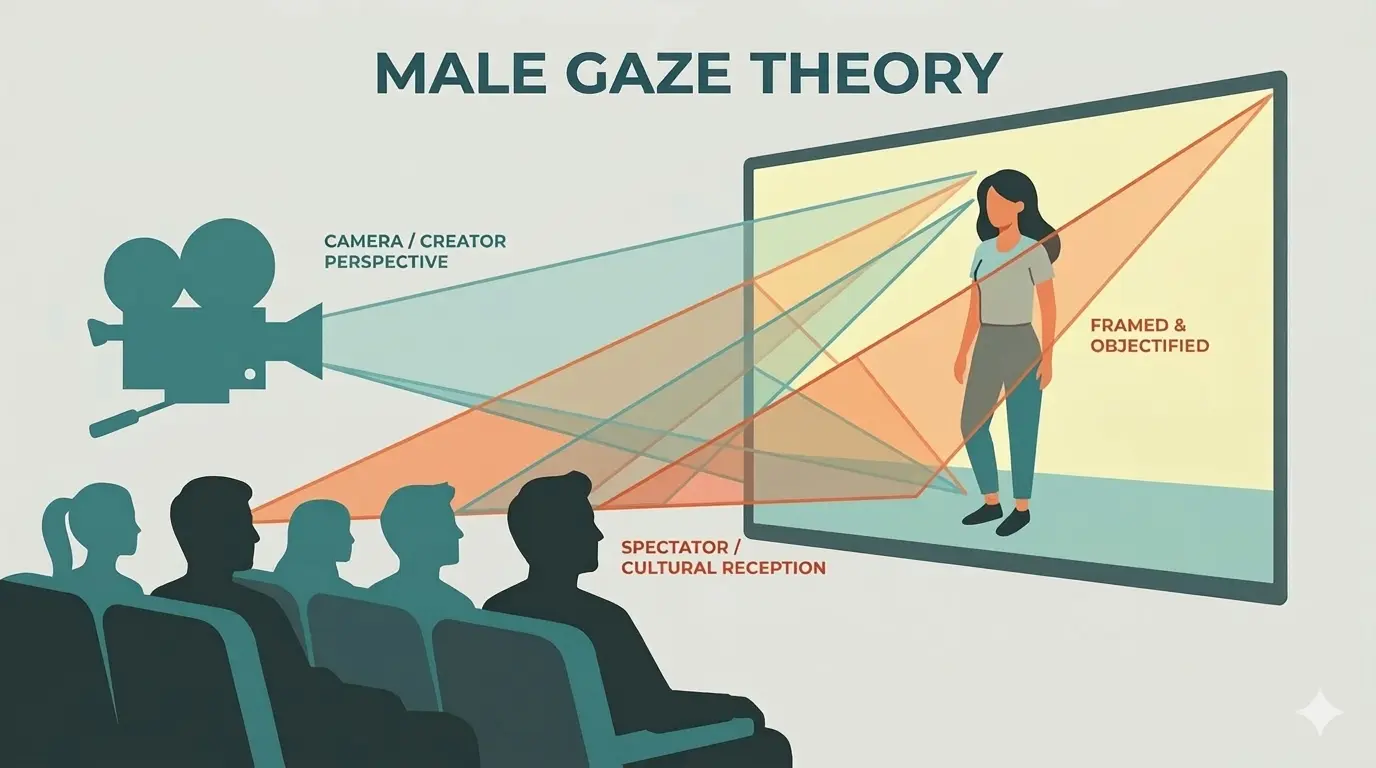
Representation in media plays a crucial role in shaping how societies understand gender roles and power relations. One of the most influential concepts used to analyze gender representation in visual media is the male gaze. The term refers to a way of portraying and viewing women that places men in a position of visual authority while often presenting women as objects of visual pleasure.
Within this framework, women are frequently depicted as figures to be looked at, while male characters are more often positioned as active agents who control the narrative. This pattern appears prominently in films and television and also influences broader cultural attitudes toward women. As a result, the male gaze can shape social perceptions of femininity and influence how women view themselves within media-driven cultures. Understanding the male gaze therefore provides an important framework for examining how media representations contribute to the social construction of gender roles and power relations.
Scholar and Theoretical Background
The concept of the male gaze was developed and popularized by Laura Mulvey, a British feminist film theorist, filmmaker, and scholar associated with Birkbeck, University of London. Mulvey introduced the theory as part of a feminist critique of mainstream cinema.
Her work draws on psychoanalytic theory, particularly the ideas of Sigmund Freud and Jacques Lacan. Freud’s concept of scopophilia refers to the pleasure derived from looking at others as objects. Mulvey argued that cinema often mobilizes this pleasure by presenting women as objects of visual attention. Mulvey also engaged with Lacan’s concept of the mirror stage, which explains how individuals develop identity by identifying with images. In the cinematic context, audiences frequently identify with the perspective of the camera, which is often aligned with the viewpoint of the male protagonist. Through this identification, viewers may unconsciously adopt a masculine viewing position. By combining feminist theory and psychoanalysis, Mulvey demonstrated how cinematic language and visual structure can reproduce patriarchal ways of seeing.
Origin of the Male Gaze Theory
Ideas about how visual culture positions women as objects of observation were discussed earlier by John Berger in Ways of Seeing (1972). Berger argued that in Western visual traditions women are often presented as objects to be looked at, while men are positioned as observers.
However, the concept received its most influential theoretical formulation through Laura Mulvey’s essay “Visual Pleasure and Narrative Cinema” (1975). Published in the journal Screen, the essay became a foundational text in feminist film theory. Mulvey analyzed how classical Hollywood cinema structures visual pleasure around a male perspective. Films often encourage viewers to adopt the viewpoint of a male protagonist, positioning women as objects of visual attention rather than as subjects with narrative agency.
Meaning of the Male Gaze
At its core, the male gaze refers to a visual perspective that represents women through a patriarchal and heterosexual framework of looking. Within this structure, cinematic techniques frequently align the audience with a masculine viewing position.
As a result, the female body becomes something to be watched, admired, or desired. Mulvey argued that in many films women function as “bearer of meaning, not maker of meaning.” In other words, female characters often serve symbolic or decorative roles within narratives centered on male action and agency. This dynamic reinforces cultural patterns in which men are associated with activity and control, while women are associated with appearance and spectacle.
Key Elements of the Theory
Objectification of Women
One of the most important aspects of the male gaze is the objectification of women. Female characters are frequently presented as erotic objects both for male characters within the narrative and for viewers watching the film. Cinematic techniques such as slow camera movement, close-ups, and fragmented shots of body parts can emphasize visual attractiveness and sexual appeal.
Visual Pleasure and Spectatorship
Mulvey argued that cinema provides visual pleasure through forms of voyeuristic looking. The darkened cinema space allows spectators to observe characters on screen without being seen themselves, creating the experience of watching a private world unfold.
Active Male / Passive Female Roles
Another key element is the narrative structure in which male characters typically drive the story forward. Male protagonists are often portrayed as active agents, while female characters may appear as visual attractions whose presence sometimes pauses the narrative to emphasize their appearance.
Examples from Film and Media
Classical Hollywood Cinema
The male gaze can be observed in many classical Hollywood films. For example, Alfred Hitchcock’s Rear Window (1954) revolves around a male protagonist who observes his neighbors through a window, transforming their lives into objects of voyeuristic observation.
Film Noir
In film noir, the appearance of the femme fatale often interrupts the narrative. In films such as The Postman Always Rings Twice (1946), the camera frequently lingers on the female character’s body, encouraging the audience to view her through a sexualized lens.
Action Films
Popular action franchises such as James Bond films frequently introduce female characters as “Bond girls.” These characters are often framed through visual cues that emphasize attractiveness and sexuality, reinforcing patterns associated with the male gaze.
Relevance in Contemporary Media
Although Mulvey developed her theory primarily in relation to classical Hollywood cinema, the concept has been widely applied to other forms of visual media.
Music Videos
Music videos sometimes emphasize the sexualized presentation of female performers, placing visual attention on bodies and appearance rather than artistic expression.
Advertising and Digital Media
Advertising frequently uses images of women to attract attention and promote products. These representations may position women as decorative elements rather than independent subjects.
Social Media
Social media platforms such as Instagram and TikTok can also reflect dynamics related to the gaze. Users sometimes present curated images that align with dominant standards of beauty. In certain cases this may contribute to self-objectification, where individuals begin to view themselves from the imagined perspective of external observers.
Critical Perspectives and Significance
Mulvey’s theory has played a major role in feminist media analysis by revealing how visual culture can reproduce gender inequality. By identifying the male gaze, scholars and audiences can better understand how power operates through visual representation. However, the theory has also inspired debate and further theoretical development.
The Female Gaze
Some scholars and filmmakers have explored the idea of a female gaze, which attempts to represent women’s experiences and perspectives differently from traditional cinematic conventions.
Intersectionality
Researchers have also noted that visual representation intersects with race, class, and cultural identity. Media images have historically exoticized Asian women and hypersexualized Black women, demonstrating that representation operates through multiple systems of power.
Psychological Impact
Contemporary research in media and psychology suggests that repeated exposure to objectifying images can contribute to self-objectification, body dissatisfaction, and reduced self-esteem among audiences.
Conclusion
The concept of the male gaze, developed by Laura Mulvey in 1975, remains one of the most influential frameworks for analyzing gender representation in visual media. The theory demonstrates how cinematic techniques and narrative structures often position women as objects of visual pleasure while granting men the role of active subjects. By examining how the gaze operates across film, advertising, and digital media, scholars can better understand how media shapes perceptions of gender and identity. Recognizing the male gaze also encourages audiences and creators to challenge traditional patterns of representation and promote more diverse and empowered portrayals of women.
References
- Mulvey, L. (1975). Visual Pleasure and Narrative Cinema. Screen, 16(3), 6–18.https://www.amherst.edu/system/files/media/1021/Laura%20Mulvey%2C%20Visual%20Pleasure.pdf
- Berger, J. (1972). Ways of Seeing. London: Penguin Books.
- Verywell Mind. (2023). What Is the Male Gaze? https://www.verywellmind.com/what-is-the-male-gaze-5118422
- Perlego. (2023). Laura Mulvey’s Male Gaze Theory Explained.
https://www.perlego.com/knowledge/study-guides/what-is-laura-mulveys-male-gaze-theory