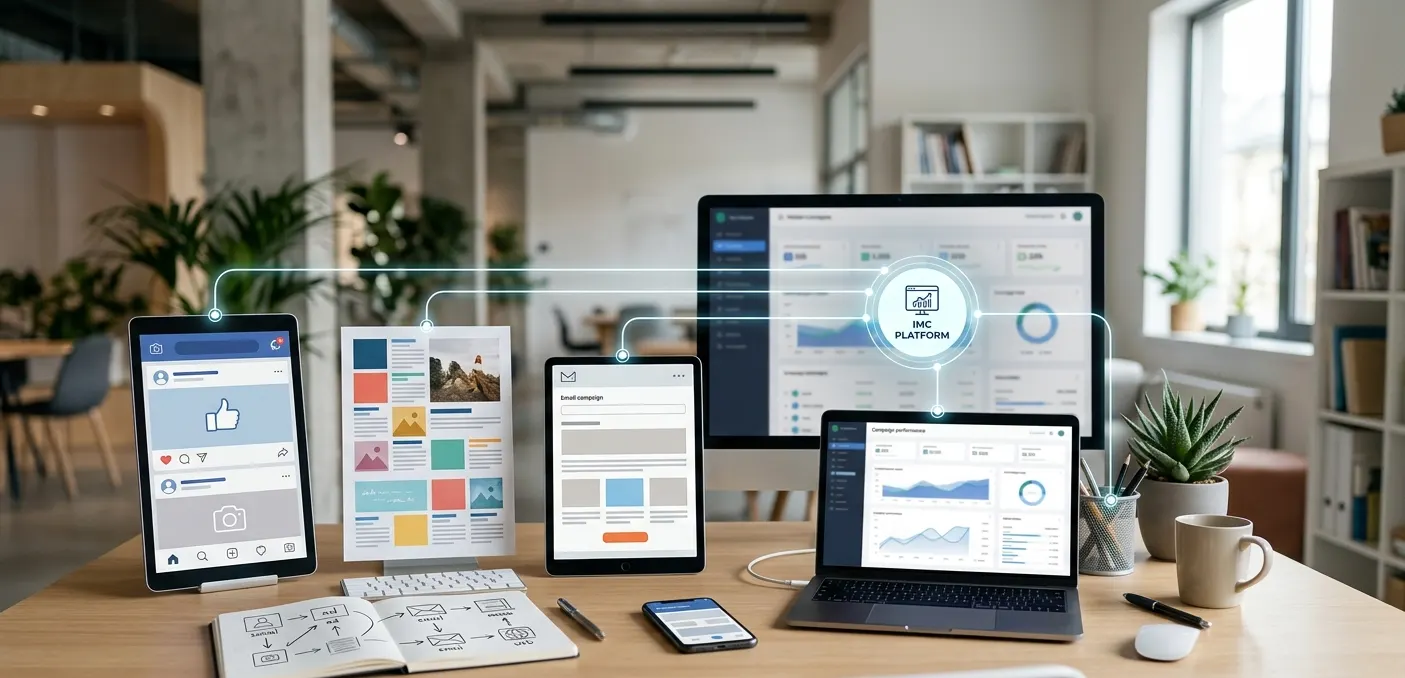




Imagine a brand that promotes itself differently on every platform. On television, it presents itself as premium. On social media, it looks casual and inconsistent. Through email marketing, it gives a completely different message. For a consumer, this creates confusion rather than trust.
This is exactly the problem that Integrated Marketing Communication (IMC) tries to solve. It brings all communication efforts together and ensures that a brand speaks in one clear, consistent voice across all platforms.
Understanding the Meaning of IMC
Integrated marketing communication (IMC) is a strategic approach that involves coordinating and integrating different marketing communication tools and channels to deliver a clear, consistent, and unified message to the target audience. It ensures that all forms of communication work together rather than in isolation, thereby enhancing the overall effectiveness of brand communication.
According to Kotler and Armstrong, IMC focuses on aligning multiple communication channels to create clarity and consistency in brand messaging. Similarly, scholars like Schultz and Kitchen view IMC as a long-term strategic process that helps organizations build strong relationships with customers through coordinated communication efforts.
In today’s media environment, where consumers interact with brands across multiple platforms, IMC plays a crucial role in ensuring that every message reinforces the same brand identity and purpose.
Role of IMC in Modern Marketing
Today’s consumers interact with brands across many touchpoints. They may first see a product on Instagram, then read reviews online, and finally watch an advertisement on television. If the message changes at each stage, the consumer may lose confidence in the brand.
IMC ensures that communication remains connected across all these touchpoints. It creates a seamless experience where each message reinforces the other. This integration also makes communication more effective. Instead of working in isolation, different marketing tools support each other and increase the overall impact.
How IMC Strengthens Brand Communication
- One of the biggest strengths of IMC is consistency. When a brand communicates the same message across platforms, it becomes easier for consumers to recognize and remember it.
- Consistency also builds trust. Consumers are more likely to believe a brand that delivers a clear and stable message rather than one that keeps changing its identity.
- Another important benefit is better engagement. When messages are aligned, consumers find it easier to connect with the brand. This improves their overall experience and increases the chances of long-term loyalty.
- IMC also helps organizations use their resources more efficiently. Instead of creating separate campaigns for each platform, they can develop one unified strategy that works across all channels.
Tools Used in Integrated Marketing Communication
IMC works through a combination of communication tools. Each tool has a specific role, but all of them are connected through a common strategy.
- Advertising is often the most visible element. It helps create awareness and reach a large audience through television, print, radio, and digital platforms.
- Sales promotion focuses on short-term incentives such as discounts and special offers. It encourages consumers to take immediate action.
- Public relations plays a different role. It builds a positive image of the organization through media coverage, events, and communication with the public.
- Direct marketing allows brands to communicate personally with consumers through emails, messages, or targeted campaigns.
- Personal selling becomes important when direct interaction is needed, especially for high-value or complex products.
- Digital marketing has now become central to IMC. Social media, websites, and content platforms allow brands to interact with consumers in real time and maintain continuous engagement.
- The effectiveness of IMC depends on how well these tools are integrated. The goal is not to use more tools, but to use them in a connected way.
IMC Strategy: How It Works in Practice
- IMC is not just a concept; it is a planned process. It begins with understanding the target audience. Brands need to know who their consumers are, what they need, and how they behave.
- Once the audience is defined, communication objectives are set. These objectives may include creating awareness, building brand image, or increasing sales.
- The next step is developing a clear and consistent message. This message becomes the foundation of all communication activities.
- After that, the message is adapted for different platforms without changing its core meaning. This ensures consistency while allowing flexibility in presentation.
- Finally, the entire communication process is evaluated. Feedback and performance data help improve future strategies.
Applications of IMC in Practice
A good example of IMC can be seen in a product launch. A company may use television advertising to create awareness, social media to engage users, and promotional offers to drive sales. At the same time, public relations activities may highlight the product in news coverage. Even though different tools are used, the message remains consistent. This creates a strong and unified brand presence.
Advantages of IMC
IMC offers several benefits that make it an essential part of modern marketing.
- It improves brand recognition by maintaining a consistent identity. Consumers can easily identify and remember the brand.
- It increases the effectiveness of communication because different tools support each other. This creates a stronger overall impact.
- It also reduces costs by avoiding duplication of efforts. A single integrated strategy is more efficient than multiple disconnected campaigns.
- Most importantly, IMC improves the consumer experience. When communication is clear and consistent, consumers feel more confident in their decisions.
Challenges in Implementing IMC
Despite its advantages, IMC is not always easy to implement.
- One of the main challenges is coordination. Different teams and agencies may handle different communication channels, making it difficult to maintain consistency.
- Another challenge is maintaining a unified message across platforms. Each platform has its own style and format, which requires careful adaptation.
- The rapidly changing digital environment also adds complexity. New platforms and technologies require constant updates in strategy.
- However, with proper planning and understanding, these challenges can be managed effectively.
Conclusion
Integrated Marketing Communication is not just a marketing technique; it is a strategic approach that brings clarity, consistency, and effectiveness to brand communication. In a world where consumers interact with brands through multiple channels, IMC ensures that every interaction reinforces the same message. By integrating different tools and maintaining a unified voice, organizations can build stronger relationships with their audience and achieve better results.
References
- Cambridge University Press. (2014). Integrated marketing communication (Excerpt).
- Masters in Communications. (n.d.). What is integrated marketing communications?
- GeeksforGeeks. (n.d.). Integrated marketing communication (IMC): Meaning, importance, tools and examples.
- Indira Gandhi National Open University. (n.d.). Integrated marketing communication (Unit 1).