

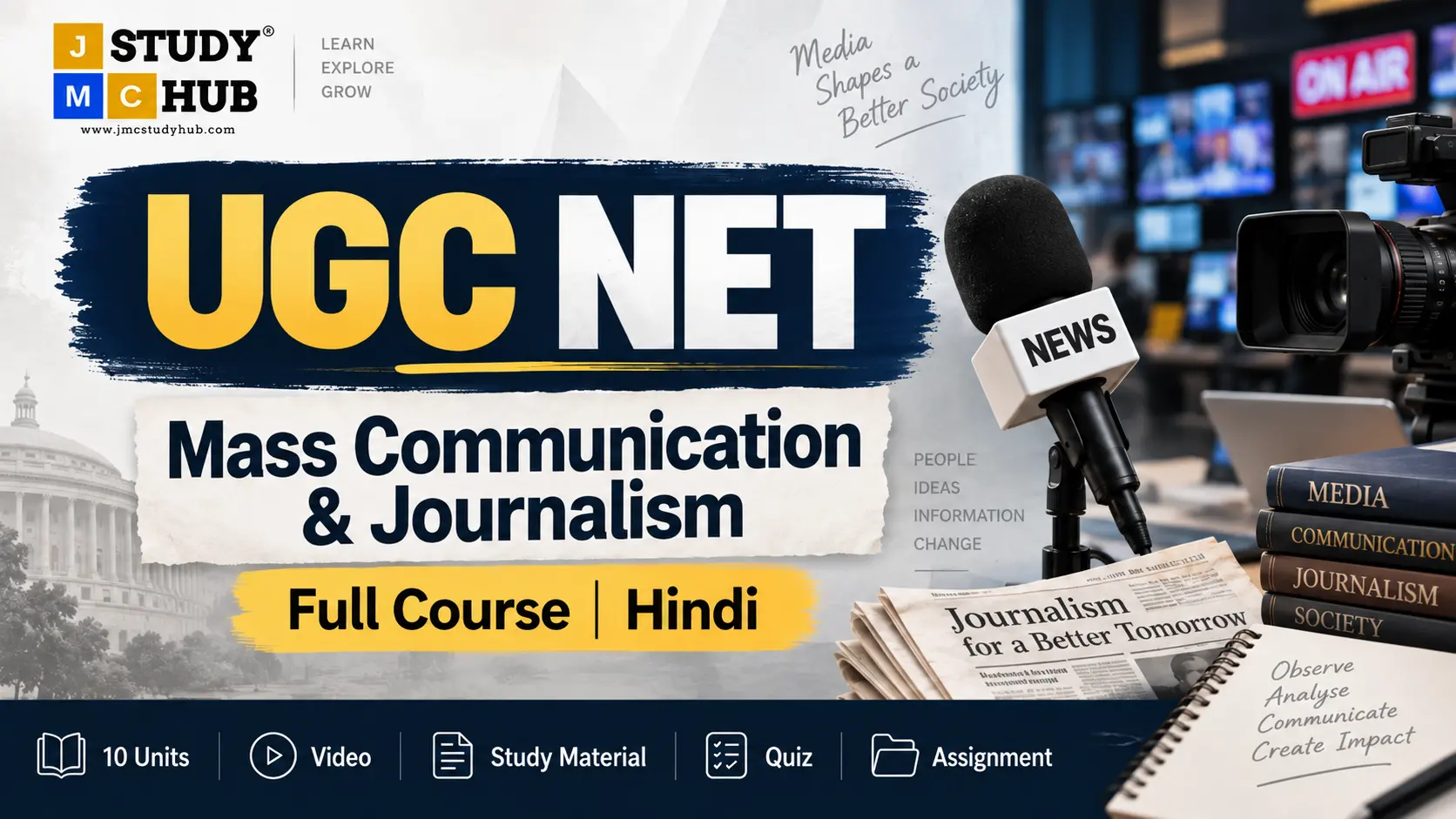
About Course
Prepare Smarter for UGC NET Mass Communication & Journalism
Want to qualify UGC NET in Mass Communication & Journalism and move closer to your JRF or Assistant Professor eligibility goals?
This Bilingual-medium course is designed to make your preparation more clear, structured, and exam-focused. Instead of studying from scattered resources, you get a complete learning path that helps you understand concepts, practise regularly, and revise with confidence.
The course follows the full UGC NET Mass Communication & Journalism syllabus (Subject Code 63) covering all 10 units—from communication theories, journalism, advertising and public relations to media laws, ICT, film studies and communication research.
Everything You Need to Prepare in One Place
Video Lectures: Understand important topics through clear and easy-to-follow Hindi explanations.
Study Materials: Revise concepts with organised learning resources aligned with the syllabus.
Practice Quizzes: Check your understanding regularly and identify areas that need more attention.
Course Assignments & Exercise Files: Strengthen learning through practice and application.
Learn with a Clear Preparation Flow
Understand → Practise → Revise → Improve
On the JMC Study Hub platform, you can follow lessons in sequence, keep track of your progress, save notes for revision, access learning resources, and revisit important topics whenever required.
Whether you are beginning your UGC NET journey or strengthening your existing preparation, this course helps you approach the syllabus with better clarity, consistency, and direction.
Build Your Preparation with Confidence
A broad syllabus becomes easier when your learning is organised and your practice is regular. This course gives you a focused path to study the subject systematically and prepare with a stronger understanding of the concepts that matter.
Start your UGC NET Mass Communication & Journalism preparation with a clear plan and a smarter learning approach.
Course Content
Unit 1: Introduction to Journalism and Mass Communication
-
12:05
-
Quiz_Concept of Journalism & Mass Communication
-
08:15
-
Quiz_Mass Communication in India
-
10:41
-
Quiz_History, Growth, and Development of Print Media
-
07:07
-
History, Growth, and Development of Electronic Media
-
12:35
-
Major Landmarks in Print Media in Indian Languages
-
L6: Major Landmarks in Electronic Media in Indian Languages
13:49 -
Major Landmarks in Print Media in Indian Languages
-
L7: Media Role in Formulation of States of India
09:25 -
Media Role in Formulation of States of India
-
L8: Media Criticism and Media Literacy
08:57 -
Media Criticism and Media Literacy
-
L9: Press Council and Press Commissions of India
07:05 -
Press Council and Press Commissions of India
-
07:09
-
Status of Journalism and Media Education in India
-
L11: Media Policies of the Government of India Since Independence
08:56 -
Media Policies of the Government of India Since Independence
-
L12: Models and theories of mass communication (Part 1)
10:22 -
Models and Theories of Mass Communication (Part 1)
-
L13: Models and theories of mass communication (Part 2)
09:10 -
Models and Theories of Mass Communication (Part 2)
-
L14: Models and theories of mass communication (Part 3)
15:11 -
Models and Theories of Mass Communication (Part 3)
-
L15: Models and theories of mass communication (Part 4)
09:57 -
Models and Theories of Mass Communication (Part 4)
-
L16: Normative Theories | Four Theories of the Press
09:42 -
Normative Theories _ Four Theories of the Press
-
L17: Administrative and Critical Traditions in Communication
06:38 -
Administrative and Critical Traditions in Communication
-
L18: Communication and Theories of Socio-Cultural Context
07:16 -
Communication and Theories of Socio-Cultural Context
-
L19: Educational and Agricultural Change | Technological Determinism
08:46 -
Educational and Agricultural Change _ Technological Determinism
-
L20: Critique of Marshall McLuhan’s Views on Media and Communication
07:28 -
Critique of Marshall McLuhan’s Views on Media and Communication
-
L21: Marxist Approaches, Information, and Knowledge Societies
09:07 -
Marxist Approaches, Information, and Knowledge Societies
-
L22: Indian Traditions and Approaches to Communication from the Vedic Era to the 21st Century
09:28 -
Indian Traditions and Approaches to Communication from the Vedic Era to the 21st Century
-
L23: Western and Eastern Philosophical, Ethical, and Aesthetic Perceptions of Communication
09:50 -
Western and Eastern Philosophical, Ethical, and Aesthetic Perceptions of Communication
-
L24: Aristotle and Plato, Hindu, Buddhist, and Islamic Traditions in Communication
08:45 -
Aristotle and Plato, Hindu, Buddhist, and Islamic Traditions in Communication
-
L25: Media and Culture – A Framework for Understanding Culture in a Globalized World
10:47 -
Media and Culture – A Framework for Understanding Culture in a Globalized World
-
L26: Globalization with Respect to Politico-Economic and Socio-Cultural Developments in India
08:47 -
Globalization with Respect to Politico-Economic and Socio-Cultural Developments in India
Unit 2: Communication for Development and Social Change
Unit 3: Reporting and Editing
Unit 4: Advertising and Marketing Communication
Unit 5: Public Relations and Corporate Communication
Unit 6: Media Laws and Ethics
Unit 7: Media Management and Production
Unit 8: ICT and Media
Unit 9: Film and Visual Communication
Unit 10: Communication Research
Student Ratings & Reviews