Lesson 10: Status of Journalism and Media Education in India
Introduction
Journalism and media education in India has evolved alongside the dynamic media landscape. This lesson delves into the development, institutions, and current trends shaping media training in the country. From traditional classrooms to digital skill-building, media education plays a vital role in preparing future professionals to meet industry demands and ethical responsibilities.
Historical Perspective: The Beginnings of Media Education
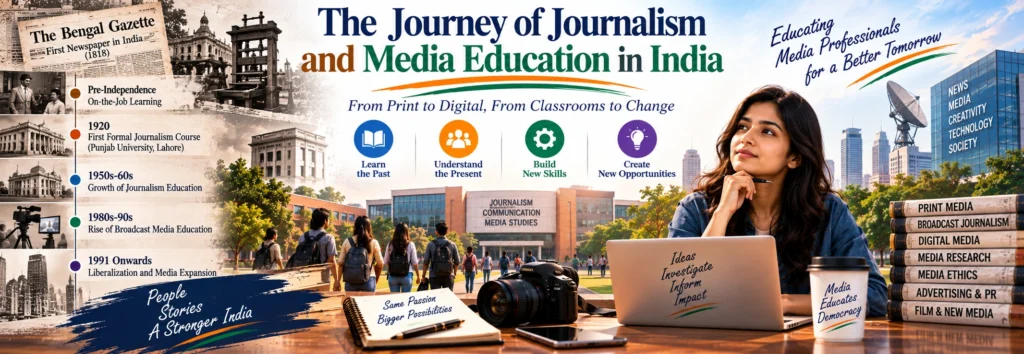
Journalism in India has deep roots—going all the way back to the early 19th century when newspapers like The Bengal Gazette started shaping public opinion. But formal education in journalism took time to develop.
- Pre-Independence Era: During this time, most journalists learned on the job. There were no structured courses or schools for journalism. Instead, skills were passed down through mentorship and practical training.
- Post-Independence Era: After independence, the need for a trained and professional press became evident. The first formal journalism course in India was introduced in 1920 at Punjab University, Lahore. It laid the foundation for structured media education.
- 1950s and 60s: With the growth of newspapers and radio, universities began offering diploma and degree programs in journalism. Osmania University and Banaras Hindu University were among the pioneers.
- 1980s and 90s: The advent of television created demand for broadcast journalism courses. Media education now began to focus not just on print but also on radio and TV broadcasting.
Growth and Expansion of Media Education in India
Today, India boasts over 200 institutes and universities offering specialized courses in journalism and mass communication. But what caused this boom?
- Media Expansion:
- The 1991 economic reforms and liberalization opened up the media sector, leading to a surge in private TV channels, FM radios, and digital platforms.
- This expansion created a demand for skilled professionals—not just reporters but editors, producers, content creators, and public relations specialists.
- Technological Advancements:
- The rise of digital media and social platforms has transformed journalism. Institutes quickly adapted their curriculum to include training in digital marketing, social media management, and multimedia production.
- Specialized Courses:
- Apart from general journalism, universities now offer specialized programs in areas like advertising, public relations, film studies, photojournalism, and media research.
- Institutes like Indian Institute of Mass Communication (IIMC), Jamia Millia Islamia, and Symbiosis Institute of Media and Communication lead the way in advanced media training.
Quick Revision TableInstitution Place / Year Distinctive Academic Focus Recall Cue Indian Institute of Mass Communication (IIMC) New Delhi · 1965 Journalism, advertising & PR, broadcast, digital communication, training and communication research. IIMC → New Delhi → Mass Communication Film and Television Institute of India (FTII) Pune · 1960 Professional education in film, television, direction, cinematography, editing, sound and screen production. FTII → Pune → Film & Television MICA Ahmedabad · 1991 Strategic communication, advertising, branding, marketing communication, media and creative management. MICA → Ahmedabad → Strategic Communication Satyajit Ray Film & Television Institute (SRFTI) Kolkata · 1995 Cinema education plus electronic and digital media; includes direction, editing, cinematography, producing and sound. SRFTI → Kolkata → Cinema + Digital Media Asian College of Journalism (ACJ) Chennai Profession-oriented journalism training with emphasis on reporting, editing, multimedia and contemporary newsroom practice. ACJ → Chennai → Journalism - International Collaborations:
- Many universities have tie-ups with international media schools to provide global exposure, internships, and exchange programs.
Current Status of Journalism and Media Education in India
Today, journalism and media education in India is multi-dimensional and technology-driven.
- Diverse Programs:
- Courses range from certificate programs to bachelor’s and master’s degrees, and even Ph.D. programs.
- Focus areas include investigative journalism, development communication, data journalism, media laws, and media ethics.
- Skill-Based Training:
- Programs emphasize hands-on training with tools like video editing software, camera handling, live reporting, and studio production.
- Practical exposure through internships and media lab simulations bridges the gap between theory and practice.
- New-Age Media Focus:
- With the dominance of online journalism, courses now include content writing, SEO strategies, data visualization, and social media strategies.
- Students also learn about artificial intelligence in journalism, like fact-checking algorithms and automated reporting.
- Emergence of Media Startups:
- Journalism schools encourage students to explore entrepreneurship in media by teaching them about blogging, vlogging, and launching independent news platforms.
| Organisation | Founded | Main Academic Role | Recall Add-on |
|---|---|---|---|
| AEJMC Association for Education in Journalism and Mass Communication |
1912 | Promotes standards in journalism and mass communication education, research, curriculum development and professional practice. | JMC Quarterly → AEJMC |
| ICA International Communication Association |
1950 | Advances communication scholarship through research networks, conferences and major peer-reviewed journals. | ICA → Communication Research |
| IAMCR International Association for Media and Communication Research |
1957 | Supports global media research, interdisciplinary scholarship, journalist education and media-literacy development. | IAMCR → Global Media Research |
| AMIC Asian Media Information and Communication Centre |
1971 | Asia-focused hub for media research, communication education, capacity building and academia–industry dialogue. | AMIC → Asia-focused Media Scholarship |
| UNESCO Media & Information Literacy | Global Educational Framework | Promotes critical media skills, information literacy, ethical participation and responsible communication education. | MIL → Critical & Responsible Media Use |
Challenges in Media Education
Despite this growth, journalism education in India faces certain challenges. Let’s discuss a few:
- Outdated Curriculum:
- While media is changing rapidly, many institutes still teach traditional theories without focusing enough on digital journalism.
- Practical Exposure:
- Some colleges lack modern infrastructure like news studios and editing suites, leaving students underprepared for real-world challenges.
- Ethical Concerns:
- With the rise of paid news and media bias, teaching ethics and accountability is more important than ever.
- Regional Disparities:
- Media education is often urban-centric, leaving students in rural areas with fewer opportunities.
- Industry-College Gap:
- A lack of collaboration between media houses and academic institutions sometimes means students don’t get enough industry exposure.
Future of Media Education in India
The future of journalism education in India is bright and dynamic:
- Integration of Technology: AI tools, virtual reality storytelling, and data journalism are becoming part of the curriculum.
- Global Collaborations: More tie-ups with foreign universities will provide students with global perspectives.
- Focus on Ethics: Institutes are revising their curriculum to place greater emphasis on media ethics and fact-checking to counter fake news.
- Skill Development: Expect more skill-based courses focusing on podcasting, video journalism, and mobile reporting.
Conclusion
Journalism and media education in India have come a long way—from informal training in newsrooms to advanced degrees in digital journalism and media analytics. As technology keeps evolving, media education is adapting to meet the challenges of modern storytelling and news dissemination. However, there’s still room for growth, especially in bridging the digital divide and focusing on ethics.
Next Lesson: Media Policies of the Government of India Since Independence
पाठ 10: भारत में पत्रकारिता और मीडिया शिक्षा की स्थिति
परिचय
भारत में पत्रकारिता और मीडिया शिक्षा ने समय के साथ निरंतर विकास किया है। मीडिया के विस्तार, तकनीकी प्रगति और बदलते सामाजिक परिवेश ने इस क्षेत्र को व्यापक और बहुआयामी बनाया है। पत्रकारिता शिक्षा का उद्देश्य प्रशिक्षित, उत्तरदायी और तकनीकी रूप से दक्ष मीडिया पेशेवर तैयार करना है, जो लोकतांत्रिक मूल्यों और नैतिक सिद्धांतों का पालन करें।
ऐतिहासिक परिप्रेक्ष्य
भारत में पत्रकारिता की शुरुआत 19वीं सदी में हुई, किंतु औपचारिक मीडिया शिक्षा का विकास धीरे-धीरे हुआ। स्वतंत्रता पूर्व काल में पत्रकारिता का प्रशिक्षण मुख्यतः अनुभव आधारित था और कोई व्यवस्थित शैक्षणिक ढांचा उपलब्ध नहीं था।
1920 में पंजाब विश्वविद्यालय, लाहौर में पहला औपचारिक पत्रकारिता पाठ्यक्रम प्रारंभ हुआ, जिसने मीडिया शिक्षा की नींव रखी। 1950 और 1960 के दशक में उस्मानिया विश्वविद्यालय तथा काशी हिंदू विश्वविद्यालय जैसे संस्थानों ने पत्रकारिता में डिप्लोमा और डिग्री कार्यक्रम आरंभ किए।
1980 और 1990 के दशक में टेलीविज़न और प्रसारण माध्यमों के विस्तार के साथ मीडिया शिक्षा में ब्रॉडकास्ट पत्रकारिता को शामिल किया गया।
मीडिया शिक्षा का विकास और विस्तार
1991 के आर्थिक उदारीकरण के बाद निजी मीडिया संस्थानों, एफएम रेडियो और डिजिटल प्लेटफॉर्म्स का विस्तार हुआ, जिससे प्रशिक्षित मीडिया पेशेवरों की मांग बढ़ी। इसके परिणामस्वरूप देशभर में पत्रकारिता और जनसंचार के अनेक संस्थान स्थापित हुए।
आज भारत में 200 से अधिक विश्वविद्यालय और संस्थान पत्रकारिता तथा जनसंचार में पाठ्यक्रम संचालित कर रहे हैं। इनमें इंडियन इंस्टीट्यूट ऑफ मास कम्युनिकेशन, जामिया मिलिया इस्लामिया और सिम्बायोसिस जैसे संस्थान प्रमुख हैं।
तकनीकी प्रगति के साथ पाठ्यक्रमों में डिजिटल पत्रकारिता, सोशल मीडिया प्रबंधन, मल्टीमीडिया प्रोडक्शन, विज्ञापन, जनसंपर्क और मीडिया अनुसंधान जैसे विषय शामिल किए गए हैं।
वर्तमान स्थिति
वर्तमान में मीडिया शिक्षा बहुस्तरीय है, जिसमें प्रमाणपत्र पाठ्यक्रम से लेकर स्नातक, स्नातकोत्तर और शोध कार्यक्रम उपलब्ध हैं। पाठ्यक्रमों में खोजी पत्रकारिता, विकास संचार, डेटा पत्रकारिता, मीडिया कानून और नैतिकता जैसे विषयों पर विशेष बल दिया जाता है।
कौशल आधारित प्रशिक्षण के अंतर्गत कैमरा संचालन, वीडियो संपादन, लाइव रिपोर्टिंग और स्टूडियो प्रोडक्शन का व्यावहारिक अभ्यास कराया जाता है। इंटर्नशिप और मीडिया प्रयोगशालाएँ छात्रों को व्यावसायिक अनुभव प्रदान करती हैं।
डिजिटल मीडिया के बढ़ते प्रभाव को देखते हुए कंटेंट लेखन, एसईओ रणनीति, डेटा विज़ुअलाइज़ेशन और सोशल मीडिया विश्लेषण जैसे विषय भी पाठ्यक्रम का हिस्सा बने हैं। कृत्रिम बुद्धिमत्ता और स्वचालित रिपोर्टिंग जैसे नए आयामों को भी शामिल किया जा रहा है।
मीडिया शिक्षा की चुनौतियाँ
तेज़ी से बदलते मीडिया परिवेश के बावजूद कुछ संस्थानों में पाठ्यक्रम अद्यतन नहीं हो पाता। कई शिक्षण संस्थानों में आधुनिक प्रयोगशालाओं और तकनीकी संसाधनों का अभाव है।
मीडिया नैतिकता, पेड न्यूज़ और पक्षपात जैसे मुद्दों ने प्रशिक्षण में नैतिक शिक्षा की आवश्यकता को बढ़ाया है। ग्रामीण और शहरी क्षेत्रों के बीच संसाधनों की असमानता भी एक चुनौती है। उद्योग और शैक्षणिक संस्थानों के बीच समन्वय की कमी के कारण व्यावहारिक अनुभव सीमित रह सकता है।
भविष्य की दिशा
भविष्य में मीडिया शिक्षा में कृत्रिम बुद्धिमत्ता, वर्चुअल रियलिटी और डेटा पत्रकारिता जैसे उभरते क्षेत्रों को और अधिक महत्व दिया जाएगा। अंतरराष्ट्रीय सहयोग और शोध उन्मुख कार्यक्रमों का विस्तार संभावित है।
नैतिक पत्रकारिता और तथ्य-जांच कौशल पर विशेष बल दिया जाएगा। पॉडकास्टिंग, मोबाइल पत्रकारिता और वीडियो स्टोरीटेलिंग जैसे कौशल आधारित पाठ्यक्रमों का विकास होगा।
निष्कर्ष
भारत में पत्रकारिता और मीडिया शिक्षा ने अनुभव आधारित प्रशिक्षण से लेकर आधुनिक तकनीक-समर्थित शैक्षणिक संरचना तक उल्लेखनीय प्रगति की है। डिजिटल परिवर्तन और वैश्विक प्रतिस्पर्धा के दौर में यह आवश्यक है कि शिक्षा प्रणाली तकनीकी दक्षता और नैतिक उत्तरदायित्व के बीच संतुलन स्थापित करे। निरंतर सुधार और अद्यतन पाठ्यक्रम के माध्यम से मीडिया शिक्षा भविष्य की चुनौतियों के लिए सक्षम पेशेवर तैयार कर सकती है।
Quick Revise (Exam Point of View)
|
विषय |
प्रमुख तथ्य |
वर्ष/काल |
|
प्रथम पत्रकारिता पाठ्यक्रम |
पंजाब विश्वविद्यालय, लाहौर |
1920 |
|
उदारीकरण |
निजी मीडिया विस्तार |
1991 |
|
प्रमुख संस्थान |
IIMC, जामिया, सिम्बायोसिस |
समकालीन |
|
मुख्य फोकस |
डिजिटल पत्रकारिता, डेटा, मीडिया कानून |
वर्तमान |
|
प्रमुख चुनौती |
पाठ्यक्रम अद्यतन और व्यावहारिक प्रशिक्षण |
समकालीन |