



The words we choose do far more than just share information; they reveal exactly who holds the language of power in our society. Think about it: our everyday metaphors and idioms act as a hidden map of social influence and prestige. In fact, we constantly use language to rank people without even realizing it. By looking closely at these common phrases, we can uncover deep ideas about how we see power, status, and importance in the world.
1. Size Matters: Why Important People Are “Big”
In our mental maps, we almost always follow the rule that importance equals size.
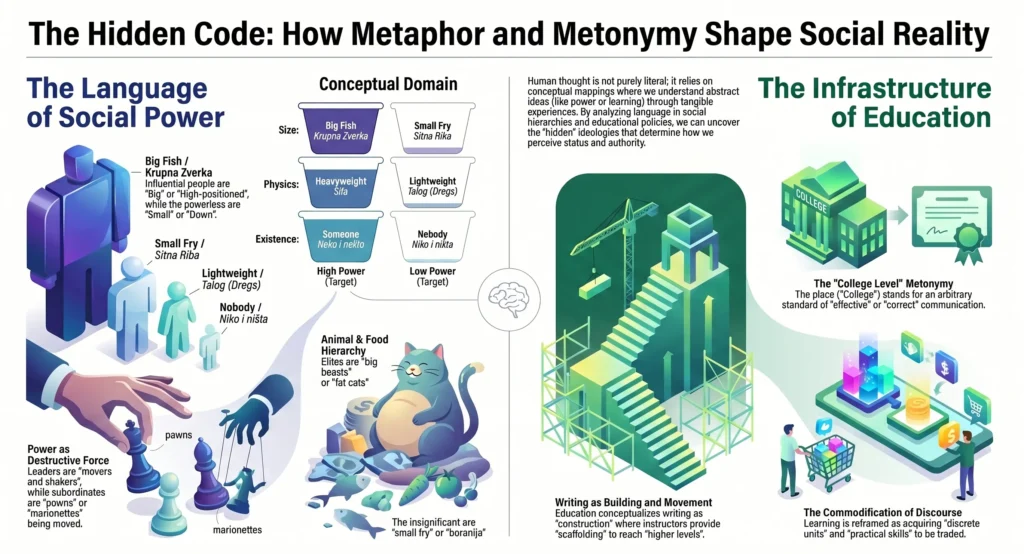
For example, we describe influential people as “big fish,” “giants,” or “magnates.” These words clearly suggest that power is something large and noticeable. Interestingly, we also use the term “fat cat” to describe wealthy elites. Over time, this term has come to represent privilege, excess, and influence. At the same time, we dismiss less powerful individuals as “small fry,” “small change,” or “small potatoes.” Through this contrast, we quietly reinforce the idea that size equals importance in the language of power.
2. The View from the Top: Height and Success
Similarly, we often describe success as movement upward. We use phrases like “top dog,” “high status,” and “friends in high places.” In the same way, ambitious people “aim high” when they want to achieve something important. Because of this, we create a mental ladder where being “up” feels powerful and being “low” feels less important. As a result, height becomes a symbol of authority in everyday communication.
3. Heavy Hitters: Power as Force
In many cases, we describe power as a kind of physical force. We call influential people “heavy hitters” or “movers and shakers” because they can create impact. In other words, we see them as people who can push change forward. On the other hand, we label those with little influence as “lightweights.” This clearly shows that, in the language of power, strength and impact matter more than anything else.
4. Life as a Game: Players and Pawns
At the same time, we often treat social life like a strategic game. We call powerful individuals “players” because they control decisions and influence outcomes. However, we reduce others to “pawns,” “puppets,” or “marionettes.” When someone is “pulling the strings,” they are controlling others from behind the scenes. This shows that we imagine powerful people as decision-makers, while others become tools in the system.
5. Being “Someone” vs. Being “Nobody”
More importantly, language directly connects power with identity. When someone has status, we call them “someone” or an “important figure.” In contrast, we describe others as “nobody” or a “nonentity.” We even say, “anyone who is anyone will be there,” which quietly excludes everyone else. Because of this, the language of power decides who gets visibility—and who gets ignored.
6. Hidden Power: When Places Stand for People
In many cases, power hides behind institutions. For example, we often hear phrases like “The White House said…” or “Downing Street announced…” In reality, people make these decisions, but we replace them with institutions. This is why such language feels more authoritative. It removes the individual and gives power a more permanent and unquestionable form.
Educational Insight
“Metaphors play an important role in shaping how societies think about power and hierarchy.”
Conclusion
Metaphors are not just colorful expressions; they shape how we understand social hierarchy. From “big fish” to “pawns,” we constantly reinforce the language of power through everyday speech. Therefore, understanding these patterns helps us see how deeply language influences our perception of status.
The next time you call someone a “big shot,” stop and think—what does that really say about power?