

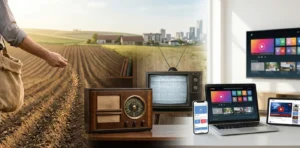

We are currently living through a profound sociological paradox. By almost every objective metric, the physical world has never been safer; in the United States, violent crime has plummeted from its 20th-century peaks and currently sits at 30-year lows. Yet, if you were to poll the person sitting next to you, they would likely describe a society spiraling into chaos. This is the “Perception Gap,” a chasm between statistical reality and our collective anxiety.
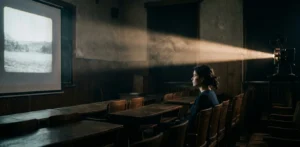
To understand this disconnect, we must look to Cultivation Theory, a framework pioneered by George Gerbner in the 1970s. Gerbner posited that the symbolic environments we inhabit—the stories, images, and news we consume—do not just entertain us; they “cultivate” our fundamental perceptions of reality. While this theory was born in the era of three-channel broadcast television, it has undergone an ontological mutation. In the age of social media, the mechanism of cultivation has shifted from a shared national narrative to a fragmented, high-velocity, and algorithmically curated immersion that is far more potent than Gerbner ever imagined.
1. Mean World Syndrome 2.0: From TV to “Doomscrolling”
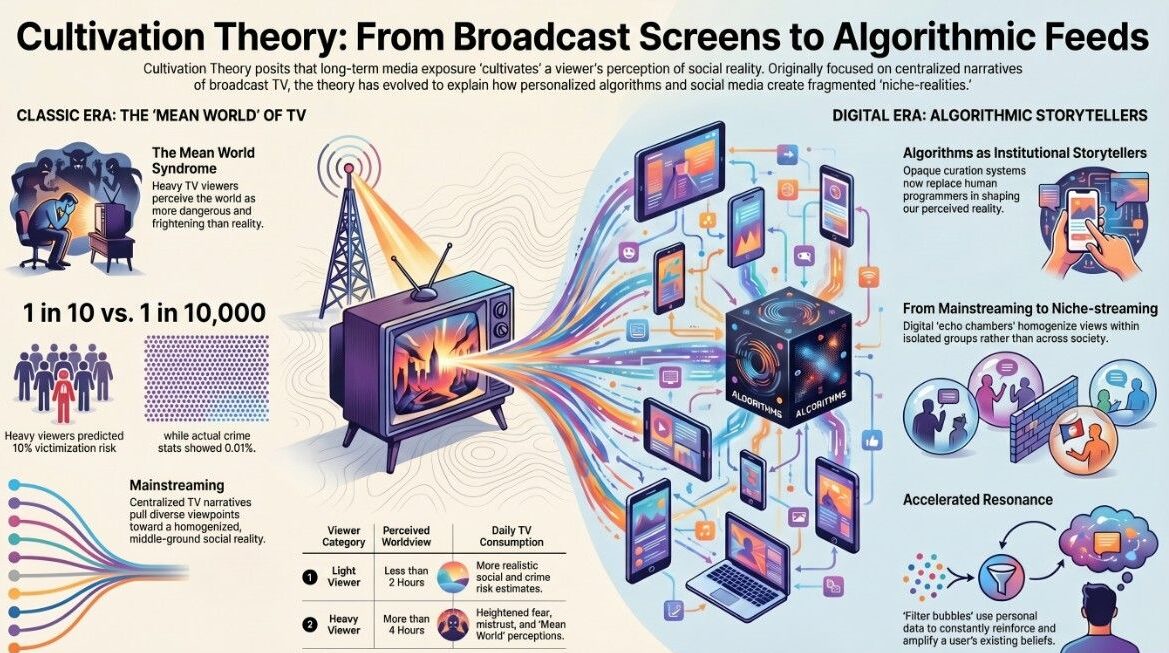
One of the central ideas in Cultivation Theory is Mean World Syndrome. Gerbner and Larry Gross (1976) found that heavy exposure to media does not necessarily make people more aggressive, but it does make them more fearful. Over time, viewers begin to perceive the world as less safe and less trustworthy than it actually is.
In the current media environment, this pattern appears in a new form—commonly referred to as doomscrolling. Continuous exposure to negative digital content—whether related to crises, conflict, or public health emergencies—has been shown to affect emotional outlook. Research such as Eslen-Ziya and Erentürk (2023) suggests that even brief interaction with such content can lower optimism and heighten anxiety. A steady flow of alarming information can gradually shape the belief that negativity is the norm rather than the exception.
2. The Death of the “Mainstream” and the Rise of “Niche-streaming”
In the broadcast era, people consumed similar media content. A limited number of television channels created a shared understanding of reality. Scholars described this process as mainstreaming, where different social groups moved toward a common perspective. Digital platforms have completely changed this pattern. Today, people consume highly personalized content. Platforms organize information based on user behavior and preferences. Scholars such as Safran Almakaty (2025) describe this shift as niche-streaming or echo-chamber mainstreaming. Instead of moving toward a shared center, audiences now split into multiple groups. Each group engages with content that reinforces its existing beliefs.
3. Algorithms and Digital Reality Perception
Media systems have changed in a fundamental way. Earlier, journalists and editors selected and shaped public narratives. Now, algorithms perform that role. They decide what users see on their screens. These systems aim to maximize engagement. They promote content that triggers strong emotional reactions such as outrage, fear, or curiosity. As a result, attention—not accuracy alone—determines visibility. Your screen does not show a neutral version of reality. It presents a curated selection that often highlights the most dramatic and extreme events.
4. The Filter Bubble is a “Resonance” Machine on Steroids
A core pillar of Gerbner’s theory is “Resonance.” Resonance occurs when media messages align with an individual’s lived experiences, making them feel more credible and immediate. In digital environments, this effect is amplified through personalization. Platforms track user behavior—what is watched, liked, or shared—and use this data to recommend similar content.
Over time, this creates a reinforcing loop. Exposure to particular types of information leads to more of the same, strengthening existing beliefs and perspectives. Safran Almakaty (2025) refers to this as technologically accelerated resonance, where algorithmic systems intensify the alignment between user perception and media content. The result is a media environment where alternative viewpoints may appear distant or less convincing.
5. The “Bifurcated Image” and the Cultivation of “Mean People”
Cultivation Theory also explains how media shapes perceptions of social groups. The idea of a bifurcated image shows how media presents different images of the same group across formats. Entertainment content may show certain communities in a positive light. At the same time, news coverage may link those same communities with crime or conflict more frequently. These patterns do not reflect the full reality. Instead, they create selective impressions. Repeated exposure to such portrayals shapes public attitudes. People begin to form stereotypes and lose trust in others. Scholars describe this outcome as the creation of “mean people”—individuals who become more cautious, less trusting, and more supportive of strict social responses.
Digital Reality Perception in the Age of AI
The next phase of media evolution is already underway. Artificial intelligence, synthetic media, and immersive technologies such as virtual and augmented reality are expanding the possibilities of personalized content. Media is no longer limited to what is broadcast or published. It can now be generated, adapted, and delivered in highly individualized forms. This raises important questions about the nature of reality itself. If each person is exposed to a different, algorithmically shaped version of the world, the idea of a shared public reality becomes increasingly difficult to maintain.