Skip to content
First 20 students get 50% discount.
Login/Register
Call: +918298628674
Email: support@jmcstudyhub.com
JMC Study Hub
  • Category
    • UGC-NET Exam
  • Home
  • About Us
  • Courses
    • UGC NET Paper-I
    • UGC NET Paper-II
    • CUET Mass Communication (UG)
    • Computer & AI Classes
    • Mock Tests
  • Study Resources
    • Quicky
    • Library
    • Previous Year Papers
    • JMC Sahitya
    • JMC Interviews
    • Mass Communication Personalities
    • Major Landmarks
0

Currently Empty: ₹0.00

Continue shopping

Try for free
JMC Study Hub
  • Home
  • About Us
  • Courses
    • UGC NET Paper-I
    • UGC NET Paper-II
    • CUET Mass Communication (UG)
    • Computer & AI Classes
    • Mock Tests
  • Study Resources
    • Quicky
    • Library
    • Previous Year Papers
    • JMC Sahitya
    • JMC Interviews
    • Mass Communication Personalities
    • Major Landmarks

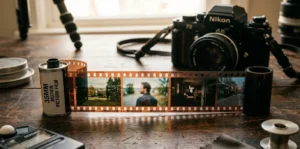
The correct sequence of the width of the film negatives:

Breadcrumb Abstract Shape
Film and visual communication

The correct sequence of the width of the film negatives:

  • November 30, 2024
  • Com 0

The correct sequence of the width of the film negatives that were used for projection is: 

(A) 16mm – 35mm – 8mm – 70mm – cinemascope

(B) Cinemascope – 8mm – 16mm – 35mm – 70mm

(C) 8mm – 16mm – 35mm – 70mm – cinemascope

(D) 8mm – 16mm – 35mm – cinemascope – 70mm

Correct Ans: (D)

Explanation: –

The evolution of film negatives for projection is based on increasing width and quality:

  1. 8mm: The smallest and narrowest format, primarily used for home movies and amateur filmmaking due to its affordability.
  2. 16mm: A step up in quality, widely used for educational, industrial, and independent film productions.
  3. 35mm: The standard format for commercial cinema for most of the 20th century, offering higher quality and broader appeal.
  4. Cinemascope: A widescreen format that uses 35mm film with anamorphic lenses to stretch the image, delivering a more immersive experience.
  5. 70mm: The widest and highest-quality format, used for epic films and large-scale theatrical releases to provide unmatched image clarity and grandeur.

This progression represents the technological advancements in cinema, making (D) the correct and logical sequence.
Assistant Professor
Dr. Ranjan Kumar

Founder & Educator

Share on:
Dr. Ranjan Kumar

Founder & Educator

Match the List-I (News Agency) with List-II (Headquarters)
The correct sequence of launching 24 hours news channels:

Leave a Reply Cancel reply

Your email address will not be published. Required fields are marked *

© 2026 - EduBlink. All Rights Reserved. Proudly powered by DevsBlink
JMC Study Hub
Sign inSign up

Sign in

Don’t have an account? Sign up
Lost your password?

Sign up

Already have an account? Sign in
Need help ?
WhatsApp
Hello, welcome to “JMC Study Hub”. How can we assist you?
Open chat