
1. The Magic of Movie Film
35mm film basics are essential to understanding how traditional cinema works. Imagine walking onto a movie set in 1940. There are no SD cards, no digital sensors, and no “instant replay” on a monitor. Every frame of the story is captured on a physical strip of film that reacts to light through a delicate process of chemistry. Before the digital age, this was the only way to tell stories on the big screen.
To truly understand cinematography, you need to understand how 35mm film works. It is not just about “old” technology; it is about a physical medium that has a unique character and visual depth. In this, we will explore film stocks and processing to see how a simple strip of film becomes the cinematic images we see in theaters.
2. What exactly is 35mm Film?
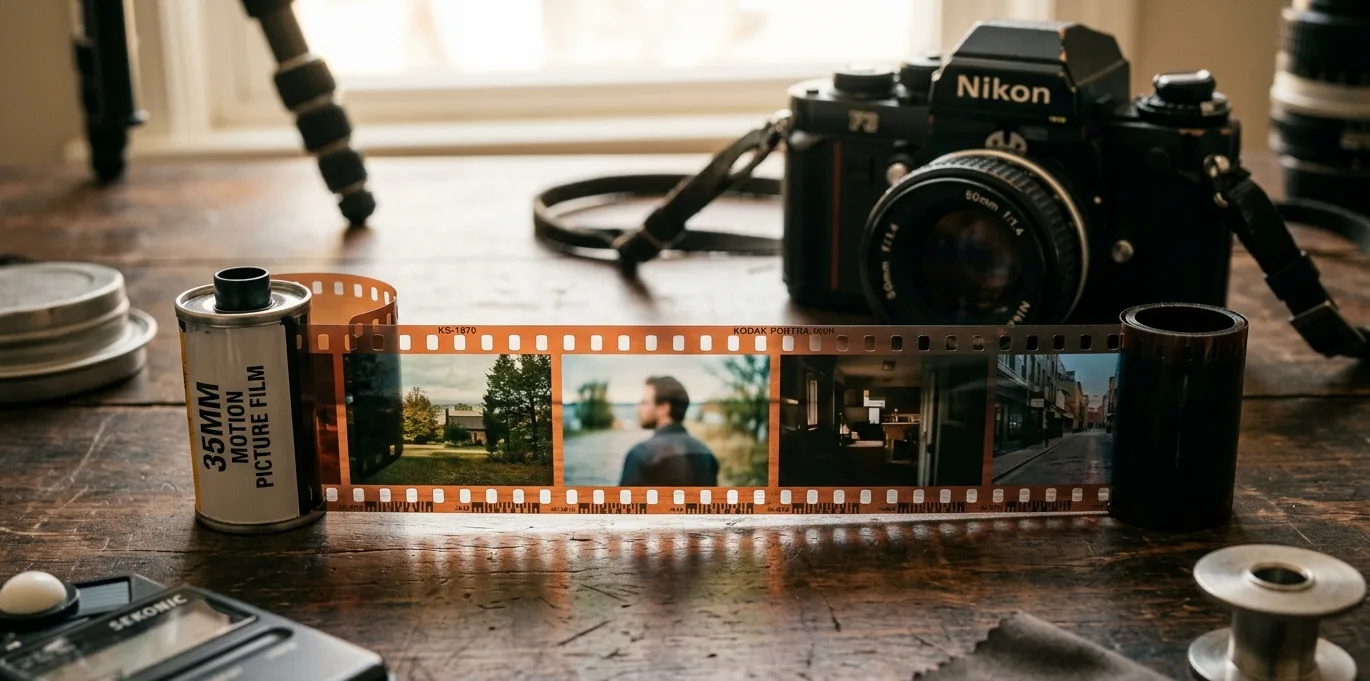
Before going into technical details, let’s understand this in the simplest way. A 35mm film is a long strip of plastic that stores images using light. This strip moves inside a camera, and each moment is captured as a small picture called a frame. If you look closely at a film strip, you will see many small images placed one after another. When these images play quickly, they create movement. That is what we see as a movie. The term “35mm” refers to the width of the film strip (35 millimeters). This size became the standard for cinema because it gives a good balance between quality and cost. Physically, a strip of film is a high-tech sandwich made of two primary layers:
- The Base: This is the flexible, transparent support. Historically, this is where things got dangerous. Until the 1950s, film was made of Cellulose Nitrate, which was famously flammable and could lead to theater fires. It was eventually replaced by ‘Safety Film’ (Acetate and later Polyester), which is much more stable.
- The Emulsion: This is the ‘magic’ layer. It’s a mixture of gelatin and microscopic, light-sensitive silver halide crystals. When light hits these crystals, the journey of the image begins.
While many sizes (or ‘gauges’) of film exist, 35mm became the industry standard for cinema in 1909.
3. What are Film Stocks?
‘Film stock’ refers to the raw, unexposed film. Different stocks act like different ‘profiles’ for your camera, determining the contrast, color, and grain of your image.
- Negative Film: The most common camera stock. It records a ‘flipped’ image where darks are light and colors are the opposites (complements) of reality.
- The Orange Mask: You may notice that negative film has a dull orange tint. This ‘mask’ is a technical feature built into the stock to improve color reproduction during the printing process. Expert Tip: Both the original camera negative and the Interpositive (IP) have this orange mask.
- Positive (Print) Film: This is the stock used for theater projection. It shows colors and light exactly as we see them in the real world.
- Reversal Film: A special type of stock (like a photo slide) that creates a positive image directly on the original film used in the camera. It can be projected immediately after it’s developed.
4. B&W, Color, and the Mystery of ISO
The way film ‘sees’ the world depends on its chemistry and its sensitivity, which we call ISO (or ASA).
Black & White vs. Color In Black & White film, there is typically a single layer of silver salts. Once developed, these salts turn into metallic silver, which stays on the film to form the image. Color film is much more complex, using three or more layers (Blue, Green, and Red). These layers contain ‘color couplers’ that create dyes when the film is developed.
Responsivity and Film Speed (ISO) ISO tells us how sensitive the film is to light. Silver halide grains are naturally more sensitive to blue light, which is why experts look at different ratings for different lighting.
- Daylight vs. Tungsten: A stock like Kodak Double-X is rated at 250D (Daylight) but only 200T (Tungsten/Indoor light) because artificial light has less blue spectrum for the silver to ‘grab’ onto.
- High ISO (e.g., 500): ‘Fast’ film for dark rooms.
- Low ISO (e.g., 50): ‘Slow’ film for bright sunshine.
5. How Film Processing Works (The Science Lab)
The journey from a camera to a screen involves three active steps in a chemical lab:
- Exposure: Light hits the film, creating an invisible latent image—a chemical ‘memory’ of the light.
- Developing: Chemicals convert the invisible latent image into a visible one by turning exposed silver salts into dark metallic silver.
- Bleaching & Fixing: Here is the big difference: In B&W processing, the metallic silver stays to form the image. In Color processing, the silver is a ‘placeholder’; it is bleached and washed away, leaving only the colored dyes behind.
6. Understanding Processing Generations: The ‘Photocopy’ Rule
In the traditional workflow, we rarely project the actual film that was in the camera. We make copies. Think of this like a photocopy: if you copy a copy, the result gets slightly worse each time.
- 1st Gen: Original Camera Negative (OCN): The highest quality. It was physically inside the camera on set.
- 2nd Gen: Interpositive (IP): A positive copy made from the OCN. It still has the orange mask but shows a positive image.
- 3rd Gen: Internegative (IN): A negative copy made from the IP.
- Technical Strategist Note: We make INs because the OCN is too precious to use for printing hundreds of copies. A single negative can only survive a few hundred ‘runs’ through a printing press before it wears out, so we strike multiple INs to protect the original.
- The ‘Back-to-Back’ Result: If you accidentally print a negative onto another negative stock for an intermediate step, you get what is called a back-to-back film, creating a duplicated or reversed effect.
The Clarity Rule: Every time you make a copy of a film (a new ‘generation’), the image gets a little softer and loses a tiny bit of detail. This is why film restorers always hunt for the OCN!
7. Film vs. Digital: Why People Still Love Film
Digital is fast, but 35mm film has an ‘aesthetic’ that digital sensors struggle to perfectly replicate. The organic ‘grain’ and the way film handles highlights give it a timeless look.
Today, we use a Digital Intermediate (DI) workflow: we shoot on film, scan it into a computer at high resolution (like 4K), edit it digitally, and then either project it digitally or record it back to film.
A Warning on Preservation: Unlike digital files, film is a living, decaying medium. Acetate film can suffer from Vinegar Syndrome, where the base breaks down and releases acetic acid (which smells like vinegar). If not stored in cool, dry environments, the film will become brittle and eventually turn to dust.
8. Conclusion: Your First Step into Cinematography
Understanding 35mm film basics is essential for any filmmaker. It teaches you that every image is the result of a physical and chemical choice—from the base and emulsion you choose to the generation of the copy you are watching. By mastering these essentials, you aren’t just looking at history; you are learning the technical foundations of how light becomes art.