

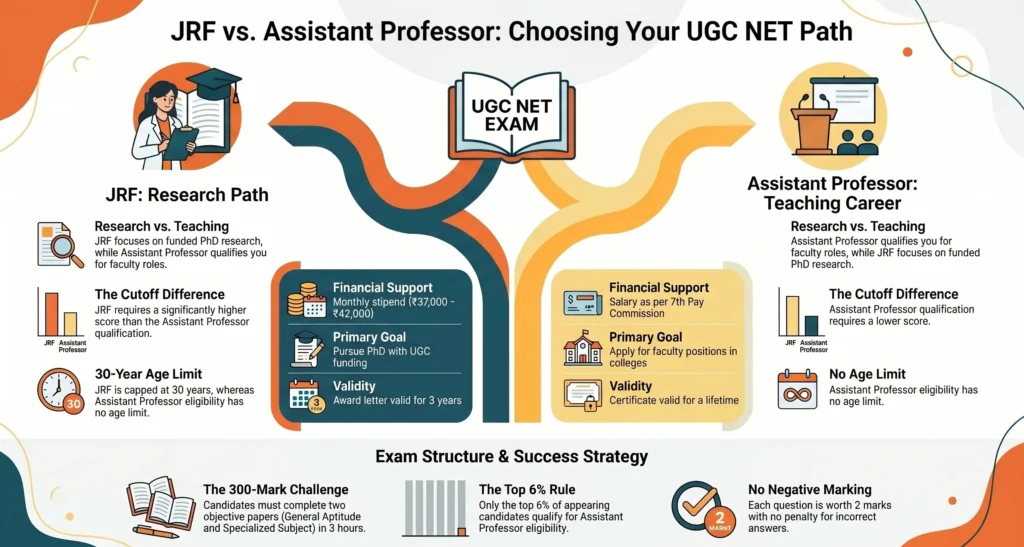
The University Grants Commission National Eligibility Test (UGC NET) is a national-level examination that determines the eligibility of Indian candidates for Assistant Professor, Junior Research Fellowship (JRF) and Assistant Professor, and admission to Ph.D. programs in universities and colleges across India. Understanding JRF vs Assistant Professor UGC NET is important for candidates who want to choose the right academic career path. The National Testing Agency (NTA) conducts this exam twice a year, usually in June and December.
The UGC NET follows a Computer Based Test (CBT) format. It includes two papers with objective-type, multiple-choice questions (MCQs). Candidates attempt both papers in a single three-hour (180-minute) session without any break.
“UGC-NET determines eligibility for three distinct categories. Category-1: Award of JRF and appointment as Assistant Professor. Category-2: Appointment as Assistant Professor and admission to Ph.D. Category-3: Admission to Ph.D. only.”
1. Exam Pattern
The UGC NET is conducted entirely in Computer Based Test (CBT) mode. The examination consists of two papers, both consisting of objective-type, multiple-choice questions (MCQs), administered in a single three-hour (180-minute) session with no break between papers.
| Feature | Paper I (General) | Paper II (Subject-Specific) |
| Focus | Teaching/Research Aptitude | Domain knowledge in the selected subject |
| Questions | 50 Questions | 100 Questions |
| Marks | 100 Marks | 200 Marks |
| Marking Scheme | 2 marks per correct answer; No negative marking | 2 marks per correct answer; No negative marking |
Paper 1 includes 50 questions (100 marks) on teaching and research aptitude.
Paper 2 includes 100 questions (200 marks) focused on the chosen subject.
There is no negative marking for incorrect answers, so candidates can attempt all questions. Candidates must meet the minimum qualifying criteria to be considered for the merit list, and final selection is based on cutoff marks determined by the examination authority.
2. Eligibility Criteria
Educational Qualifications
- Master’s Degree: Candidates must hold a Master’s degree or equivalent from a UGC-recognized university in Humanities, Social Sciences, Computer Science, etc..
- Minimum Marks: At least 55% marks for General/Unreserved/General-EWS candidates and 50% marks for OBC-NCL, SC, ST, PwD, and Third gender categories.
- Final Year Students: Those pursuing their Master’s or awaiting results can apply provisionally but must complete their degree with the required percentage within two years of the NET result (or one year for Ph.D. admission).
- 4-Year Bachelor’s Degree: Candidates with a 4-year/8-semester bachelor’s degree and minimum 75% marks (70% for reserved categories) are eligible for JRF and Ph.D. admission only; they are not eligible for Assistant Professor positions.
Age Limit and Relaxations
- Junior Research Fellowship (JRF): Candidates must be not more than 30 years old as per the prescribed cutoff date.
- Assistant Professor & Ph.D. Admission: There is no upper age limit.
Age relaxations apply for reserved categories, women candidates, and candidates with certain qualifications as per government norms.
3. Syllabus Overview
Paper I (General Paper on Teaching & Research Aptitude)
This compulsory paper assesses cognitive abilities and general awareness of the higher education system. It is divided into 10 units, with questions asked across all units:
- Teaching Aptitude
- Research Aptitude
- Comprehension
- Communication
- Mathematical Reasoning and Aptitude
- Logical Reasoning
- Data Interpretation
- Information and Communication Technology (ICT)
- People, Development and Environment
- Higher Education System
Paper II (Subject-Specific)
Candidates can choose from a wide range of subjects. This paper assesses domain knowledge in the candidate’s chosen post-graduation subject. The detailed subject-wise syllabus can be downloaded from the official UGC website.
4. Application and Fees
- Mode: Online only via the official NTA website.
- Fees: General/Unreserved: ₹1150; General-EWS/OBC-NCL: ₹600; SC/ST/PwD/Third Gender: ₹325.
- Reservation Policy: As per Government of India norms, reservation is applicable for different categories including SC, ST, OBC-NCL, EWS, and PwD.
Candidates with benchmark disabilities are provided necessary support such as compensatory time and assistance, as per official guidelines.
JRF vs Assistant Professor UGC NET: The Financial Overview
Financially, the two paths offer different structures. JRF is a research fellowship, while the Assistant Professor role is a salaried position.
JRF provides a monthly fellowship (as per current UGC norms), along with additional academic support such as contingency grants. Assistant Professors are paid according to pay levels prescribed under government norms, along with allowances such as DA, HRA, and others, depending on the institution.
The “PhD Only” Category
A separate category facilitates “Admission to PhD only.” This allows candidates to use their NET scores for PhD admissions in participating universities. For such categories, NET marks may be considered along with other selection criteria such as interviews, depending on university policies. Candidates should check specific institutional requirements.
Understanding Reservation Policy
The Government of India reservation policy plays a role in determining the final merit list and selection process. Reservation benefits are applicable as per central government norms, and candidates are advised to verify their category eligibility based on official guidelines.
Winning Strategy: Why Many Candidates Target JRF
Many candidates aim for the JRF category as it provides both research funding and eligibility for teaching positions. Qualifying at a higher level can open multiple academic opportunities, including research and teaching roles.
Conclusion: Your Next Steps in Academia
Your choice depends on your academic goals and career interests. JRF supports research and doctoral studies, while the Assistant Professor path focuses on teaching careers. Proper planning and understanding of eligibility and selection criteria can help candidates make informed decisions.
Which path aligns with your vision: leading a classroom or pursuing research?