
Lesson 4: History, Growth, and Development of Electronic Media
Electronic media has revolutionized the way information is disseminated and consumed. From the invention of the radio to the rise of television and the expansion of digital platforms, electronic media has transformed communication globally. It has not only connected societies but also shaped cultures, economies, and political landscapes. This lesson will trace the history, growth, and development of electronic media, with a particular focus on its impact in India.
Early Beginnings of Electronic Media
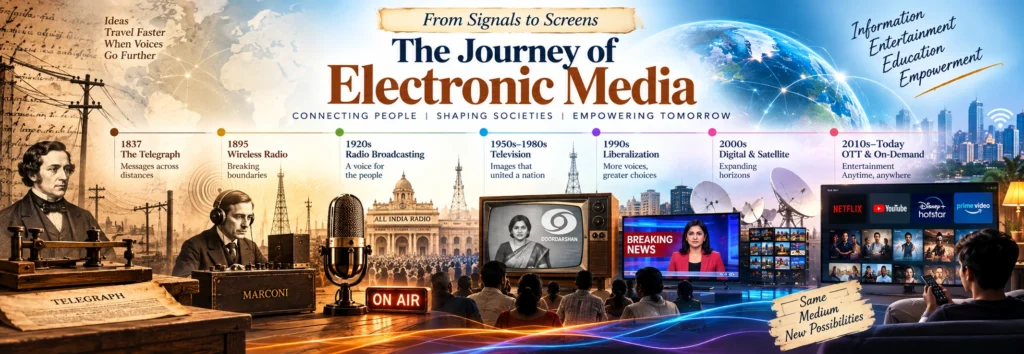
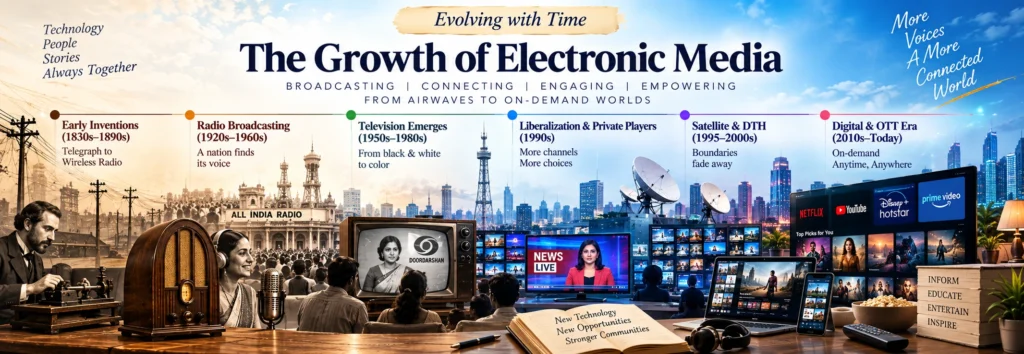
The emergence of electronic media can be traced back to the 19th century with the invention of the telegraph and radio waves. These inventions laid the foundation for modern-day electronic communication, allowing faster and broader transmission of messages.
- Telegraph (1837): Invented by Samuel Morse, the telegraph revolutionized long-distance communication. It used Morse code to transmit messages over wires, enabling real-time updates that were previously unimaginable. Governments and businesses widely adopted it to coordinate activities, setting the stage for further advancements in electronic media.
- Wireless Radio (1895): Guglielmo Marconi achieved the first successful wireless transmission, opening doors to audio broadcasting. The radio became the first medium to deliver news, entertainment, and music directly to homes, eliminating the need for physical distribution of information. It created a sense of shared experiences among listeners, especially during crises and wartime.
These early inventions paved the way for the rapid development of broadcasting technologies in the 20th century, shaping the modern landscape of electronic communication.
The Era of Radio Broadcasting
Radio broadcasting began in the early 20th century and quickly became a powerful medium for information and entertainment. It reached people in remote areas, providing a platform for information sharing, entertainment, and cultural exchange.
- 1927: India witnessed its first experimental radio broadcasts by private organizations. These broadcasts were limited but demonstrated the potential of radio as a medium of mass communication.
- 1936: The establishment of All India Radio (AIR), initially called the Indian State Broadcasting Service (ISBS), marked the formal start of organized radio broadcasting in India. AIR adopted a structured approach, airing news bulletins, cultural programs, and educational broadcasts.
- World War II: Radio gained strategic importance during the war, serving as a tool for propaganda and wartime updates. In India, it also played a role in spreading nationalist ideas, indirectly supporting the freedom struggle.
Post-Independence Growth:
- 1957: The launch of Vividh Bharati diversified programming with entertainment shows, music, and dramas, appealing to a broad audience. Vividh Bharati became a symbol of India’s cultural diversity, providing regional language programs.
- Agricultural Programs (1966): Recognizing the need for agricultural development, AIR launched programs targeting farmers. These programs offered expert advice on crop management, weather updates, and market trends, contributing to the Green Revolution.
- Community Radio (2004): Focused on grassroots-level communication, community radio stations catered to rural and marginalized communities. They broadcast content related to health, education, and local events, empowering communities through localized information.
Radio remains vital in India, especially in rural areas, due to its affordability, accessibility, and ability to operate without internet connectivity.
| Service / Milestone | Year / Association | What to Remember | Recall Cue |
|---|---|---|---|
| External Services Division | 1939 onward | International broadcasting service of AIR, designed for audiences outside India in multiple languages. | AIR beyond India |
| News Services Division | AIR news system | Handles news bulletins and current-affairs output across national and regional services. | News → AIR bulletin network |
| Vividh Bharati | 1957 | Popular entertainment service associated strongly with film music, light programmes and mass appeal. | Vividh Bharati → Entertainment |
| Commercial Broadcasting Service | 1967 | Opened AIR more systematically to commercial advertising and sponsored programming. | 1967 → Commercial Radio |
| Three-Tier Broadcasting | National · Regional · Local | AIR organizes programming at different levels to address national priorities, regional diversity and local needs. | Nation → Region → Local |
| FM Gold | AIR FM service | Urban-oriented FM service combining music, information and spoken-word programming. | FM Channel → FM Gold |
The Advent and Growth of Television
Television, often termed the “visual medium,” revolutionized entertainment and education with its ability to combine audio and visuals. It added depth to communication, making it more impactful and engaging.
- 1959: Television was introduced in India with an experimental broadcast in Delhi by Doordarshan, initially focusing on education, agriculture, and developmental programs.
- 1976: Doordarshan became an independent entity, separate from All India Radio, enabling it to focus solely on television programming. This separation allowed greater specialization and growth in television broadcasting.
- 1982: India saw the first color television broadcast during the Asian Games, marking a turning point in viewership. Color broadcasts enhanced visual storytelling, attracting larger audiences and advertisers.
Key Developments:
- 1980s: Popular serials like Hum Log (1984) and Ramayan (1987) made television a household phenomenon, drawing millions of viewers and creating shared cultural experiences.
- 1991 Economic Liberalization: The entry of private broadcasters like Zee TV, Star Plus, and Sony ended Doordarshan’s monopoly, introducing diverse programming, including soaps, reality shows, and global content.
- Satellite TV (1995): Satellite channels provided access to international content, broadening viewer choices and cultural exposure.
- DTH Services (2003): Enabled direct-to-home broadcasting, enhancing picture quality and providing access to premium channels, even in rural areas.
| Initiative / Institution | Period | Key Contribution | Recall Add-on |
|---|---|---|---|
| SITE | 1975–76 | Used satellite television for development-oriented programmes in rural India. | ATS-6 · 2,400 villages · 6 states |
| STEP | 1977–79 | Tested satellite-based domestic telecommunication systems and helped build indigenous technical capability. | SITE → Television STEP → Telecommunication |
| National Satellite Networking | 1982 | Satellite networking helped expand television beyond isolated terrestrial centres. | 1982 → Colour TV + National Network |
| Prasar Bharati | 1997 | AIR and Doordarshan became part of India’s public-service broadcasting corporation. | AIR + Doordarshan → Prasar Bharati |
| Private DTH | 2003 | Direct satellite reception reduced dependence on conventional cable distribution. | Dish → Set-top Box → Home |
| DD Free Dish | December 2004 | Prasar Bharati’s free-to-air DTH platform expanded television access without a monthly subscription fee. | Free-to-Air DTH → No monthly subscription |
Today, television continues to be a dominant medium, adapting to digital transformations through smart TVs and OTT platforms like Netflix and Hotstar.
Digital Revolution and OTT Platforms
The 21st century ushered in the digital age, transforming electronic media into an interactive and on-demand experience. The emergence of internet-based media allowed viewers to consume content anytime, anywhere.
- YouTube (2005): Allowed individuals to share and create videos, democratizing content production and consumption.
- Netflix and Amazon Prime (2016 in India): Provided streaming services, revolutionizing viewing habits with flexibility and personalized content.
- Smartphones and Mobile Apps: Platforms like Hotstar, MX Player, and Jio TV brought television and films to mobile screens, catering to modern lifestyles.
OTT platforms have redefined media consumption, making it more individualized, interactive, and mobile.
Conclusion
Electronic media has traversed a remarkable journey from radio signals to television screens and now to smartphones and digital platforms. It has become an integral part of modern life, influencing culture, politics, and education. While challenges like misinformation and censorship persist, the medium continues to evolve, adapting to technological advancements and audience needs.
References:
- Chatterjee, P. C. (1997). Broadcasting in India. Sage Publications.
- Ministry of Information & Broadcasting. www.mib.gov.in
- Thussu, D. K. (2006). Media on the Move: Global Flow and Contra-Flow. Routledge.
- TRAI Reports on TV, Radio, and OTT Growth. www.trai.gov.in
- Press Council of India Reports. www.presscouncil.nic.in
- DD Archives and Swayam Prabha data. www.swayamprabha.gov.in
- IndianTelevision.com News Archives. www.indiantelevision.com
- Netflix India Blog & Media Center. www.about.netflix.com/en/newsroom
Next Lesson – Major Landmarks in Indian Language Print Media and Cultural Development.