
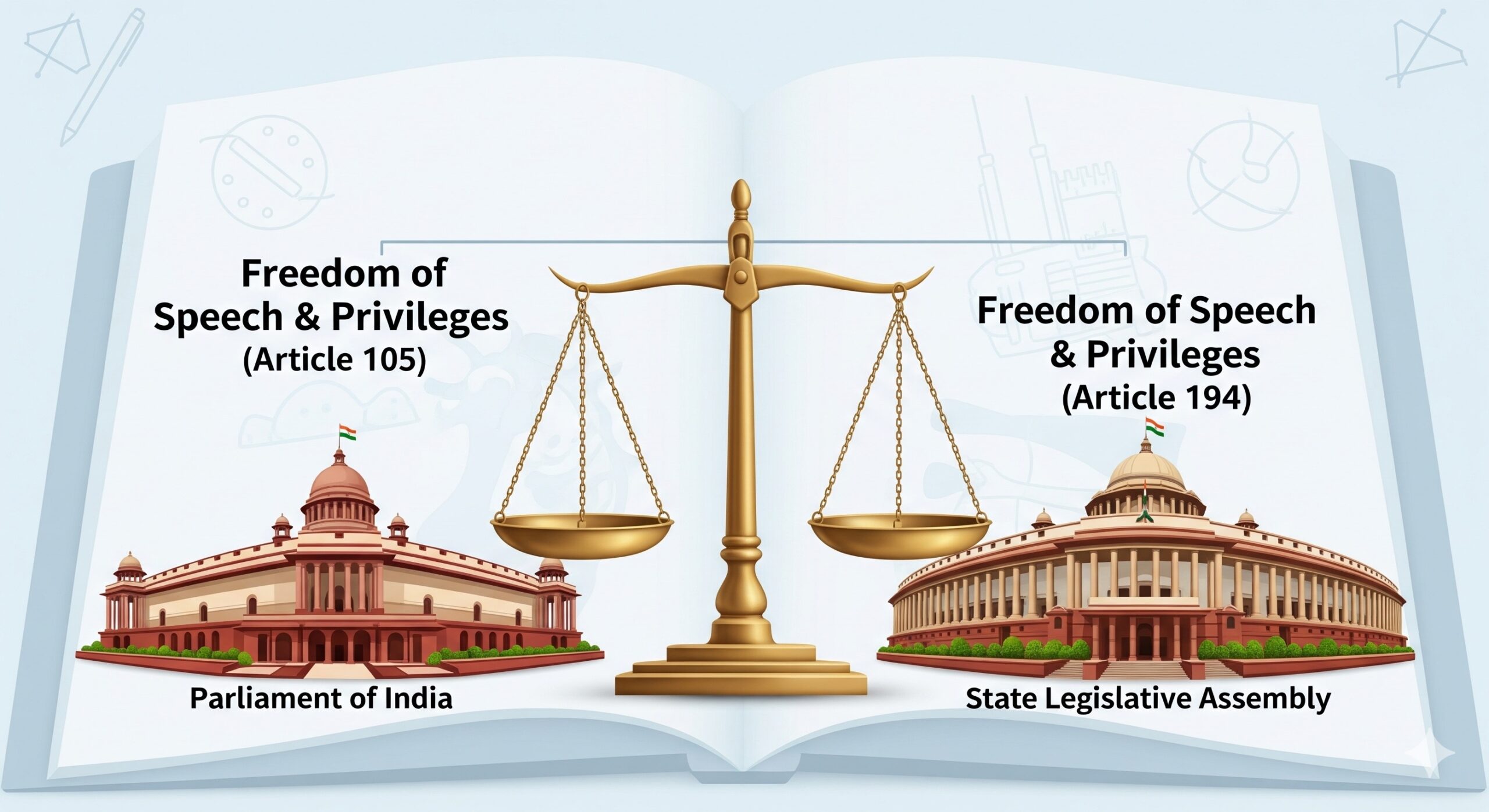





In a democracy, elected representatives need the freedom to discuss, debate, and make decisions without fear. The Constitution of India provides this protection through Article 105. This Article deals with the powers, privileges, and immunities of Parliament and its members. For students of political science and journalism, Article 105 is important because it explains why Parliament functions freely and independently.
Freedom of Speech in Parliament
The first part of Article 105 guarantees freedom of speech in Parliament. Members of Parliament (MPs) can speak freely during debates, discussions, and question hours. Their speeches cannot be questioned or punished in a court of law.
This freedom is not the same as the freedom of speech under Article 19(1)(a), which applies to all citizens. Article 105 gives MPs a special privilege inside Parliament, allowing them to express opinions without fear of defamation or legal action.
Source: Constitution of India, Article 105(1).
Immunity from Legal Action
Another key feature of Article 105 is immunity from legal proceedings. MPs cannot be held liable in court for anything they:
- say in Parliament, or
- vote for in Parliament.
This means that even controversial or unpopular statements made inside Parliament cannot become the basis for a lawsuit. This immunity ensures that debates remain fearless and robust.
Source: B. Shiva Rao, The Framing of India’s Constitution.
Parliamentary Privileges
Article 105 also talks about other powers and privileges of Parliament and its committees. Some privileges are:
- The right to regulate their own proceedings.
- The right to punish members or outsiders for breach of privilege.
- Protection of confidential discussions and documents.
Since not all privileges are written in the Constitution, Parliament has the power to define and expand them through laws.
Source: Subhash Kashyap, Parliamentary Procedure.
Importance of Article 105
The purpose of Article 105 is to maintain the independence of Parliament. Without these protections, MPs might hesitate to raise sensitive issues. It ensures:
- Free debates: MPs can discuss national issues openly.
- Checks and balances: Parliament can hold the executive accountable.
- Democratic functioning: Representatives act without fear of courts or external pressure.
In short, Article 105 strengthens democracy by giving Parliament the confidence to function independently.
Criticism and Limitations
While privileges are important, they sometimes create conflicts. For example, if an MP makes a false or offensive statement in Parliament, courts cannot take direct action. Critics argue that unlimited immunity can be misused.
However, Parliament itself has internal rules to control misconduct. The Speaker of the Lok Sabha or the Chairman of the Rajya Sabha can take disciplinary action. This balance ensures that privileges are not abused.
Source: Granville Austin, The Indian Constitution: Cornerstone of a Nation.
Comparison: Article 105 vs Article 194
| Aspect | Article 105 – Parliament of India | Article 194 – State Legislatures |
| Who it Applies To | Members of Parliament (Lok Sabha + Rajya Sabha) and parliamentary committees | Members of State Legislatures (Legislative Assembly + Legislative Council, if any) and their committees |
| Freedom of Speech | MPs have complete freedom of speech inside Parliament. Courts cannot question what they say or vote. | Same freedom for MLAs/MLCs inside State Legislature. Courts cannot question what they say or vote. |
| Immunity from Legal Action | MPs cannot be sued or prosecuted for speeches, debates, or votes in Parliament. | State legislators enjoy the same immunity for speeches, debates, and votes in the State Legislature. |
| Other Privileges | Parliament decides other privileges (like right to regulate proceedings, punish for breach, confidentiality of discussions). | Each State Legislature has the same powers regarding its own privileges and can define them. |
| Committees | Privileges also apply to parliamentary committees. | Privileges also apply to committees of the State Legislature. |
| Source of Power | Constitution of India, Article 105. | Constitution of India, Article 194. |
| Key Purpose | To ensure Parliament functions independently, without fear of courts or executive pressure. | To ensure State Legislatures function freely, representing state issues without interference. |
Conclusion
Article 105 gives Parliament the freedom and protection needed to function as the voice of the people. By ensuring free speech, immunity, and privileges, it protects MPs from external pressures. At the same time, it places responsibility on members to use these powers wisely.
For students, understanding Article 105 is key to learning how India’s democracy safeguards open debate and decision-making inside Parliament.