
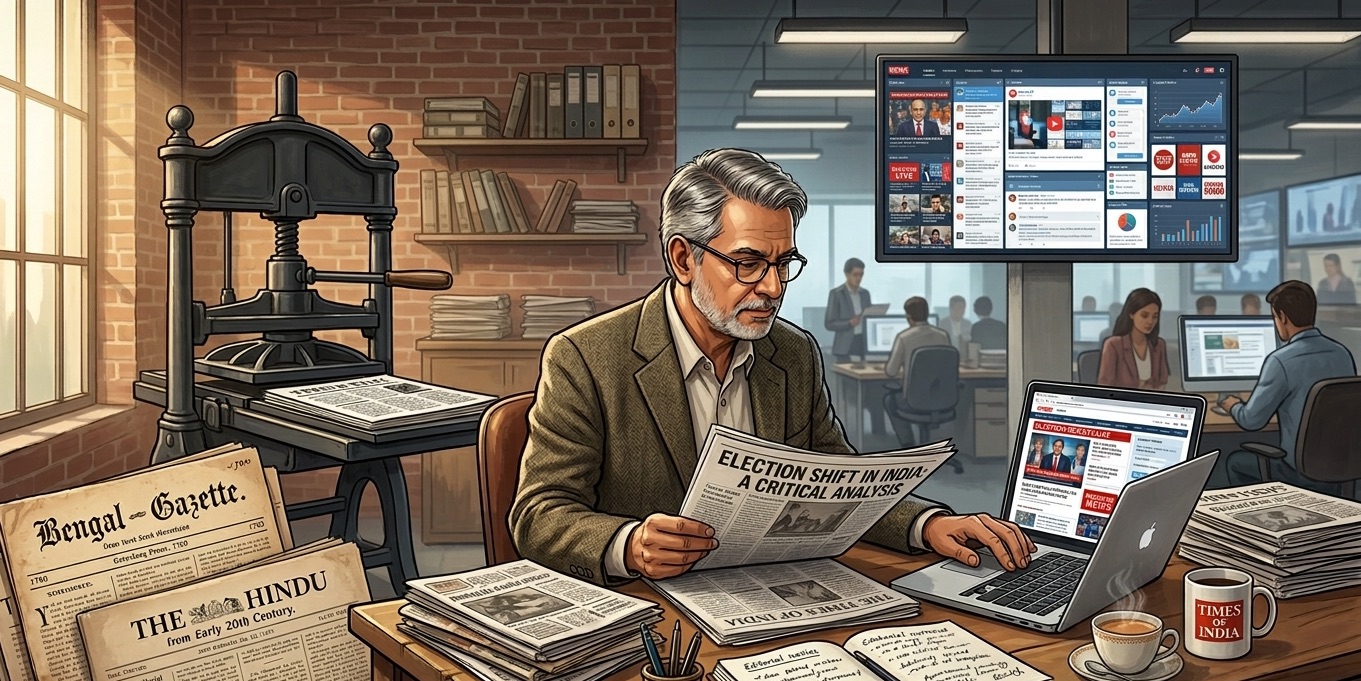
Editors occupy one of the most influential positions within the institutional structure of journalism. In any newsroom, the editor functions as the central authority responsible for determining how information is gathered, verified, and presented to the public. In India, editorial leadership has historically extended far beyond routine newsroom management. Editors have often acted as intellectual leaders who shaped public opinion, influenced political debates, and defended the freedom of the press.
Within democratic societies, journalism serves as a mechanism for transparency and accountability. Editors therefore play a crucial role in maintaining the credibility of the media by ensuring that news reporting follows professional standards of accuracy, fairness, and responsibility. Their decisions influence not only the content of newspapers and digital platforms but also the broader public discourse.
The development of editorial leadership in India reflects the broader evolution of the country’s press system—from colonial resistance journalism to modern digital media institutions. Understanding the role of editors is therefore essential for understanding the history and functioning of Indian journalism.
Early Development of Editorial Leadership in India
The origins of editorial leadership in India can be traced back to the late eighteenth century with the publication of Hicky’s Bengal Gazette or Calcutta General Advertiser, first published on 29 January 1780. Founded by James Augustus Hicky, the newspaper is widely regarded as the first printed newspaper in India. Hicky served both as publisher and editor, and his newspaper became known for its criticism of colonial authorities. Through his bold editorial stance, Hicky demonstrated early examples of editorial independence and the power of the press to challenge authority.
During the nineteenth century, journalism became closely connected with social reform movements. Raja Ram Mohan Roy, one of the most influential reformers of the period, used newspapers as platforms to advocate social and political change. Through publications such as Sambad Kaumudi (1821) and Mirat-ul-Akhbar (1822), Roy emphasized freedom of expression and public debate as essential elements of a modern society. Another important nationalist figure was Surendranath Banerjee, who founded and edited the newspaper The Bengalee in 1879. Through this publication, Banerjee advocated political reform and helped mobilize Indian public opinion against colonial rule.
By the late nineteenth and early twentieth centuries, newspapers became powerful instruments of nationalist mobilization. Bal Gangadhar Tilak, editor of the Marathi newspaper Kesari and the English weekly The Mahratta, used journalism to promote nationalist ideas and mobilize public opinion against colonial rule. Similarly, Ganesh Shankar Vidyarthi, editor of Pratap, used journalism to highlight social injustice and promote communal harmony. Another influential editor was B. G. Horniman, editor of The Bombay Chronicle, who exposed colonial repression and reported extensively on events such as the Jallianwala Bagh massacre (1919).
These early editors demonstrate how journalism in India developed in close association with political activism, social reform, and the struggle for independence.
Timeline of Indian Editors (1780–Present)
| Year | Editor | Contribution |
| 1780 | James Augustus Hicky | Founded Bengal Gazette, India’s first newspaper |
| 1821 | Raja Ram Mohan Roy | Journalism for social reform and public debate |
| 1879 | Surendranath Banerjee | Founded and edited The Bengalee |
| 1881 | Bal Gangadhar Tilak | Nationalist editor of Kesari |
| 1913 | Ganesh Shankar Vidyarthi | Founded Pratap advocating social justice |
| 1919–1920 | B. G. Horniman | Reported colonial repression and supported independence movement |
| 1950–1959 | Frank Moraes | Editor of The Times of India; strengthened professional journalism |
| 1975–1977 | S. Mulgaokar | Editor of The Indian Express who resisted press censorship during the Emergency. |
| 1980s | Arun Shourie | Investigative journalism through The Indian Express |
| 2000s–Present | Digital Editors | Managing multiplatform journalism and verification systems |
Prominent Editors in Modern Indian Journalism
Several editors have played influential roles in shaping the standards and direction of Indian journalism during the twentieth and twenty-first centuries. Frank Moraes, editor of The Times of India and later The Indian Express, contributed significantly to the professionalization of Indian journalism after independence. Pothan Joseph, one of the most respected editors in Indian English journalism, worked with newspapers such as Hindustan Times, The Statesman, and The Indian Express. His editorials helped shape the intellectual culture of Indian journalism.
B. G. Verghese, editor of Hindustan Times and later associated with The Indian Express, promoted policy-oriented journalism and analytical reporting on development issues. Kuldip Nayar, a prominent journalist and editor associated with publications such as The Statesman and The Indian Express, wrote extensively on civil liberties, diplomacy, and democratic institutions. Arun Shourie, during his tenure as editor of The Indian Express, became known for investigative journalism that exposed corruption and administrative failures. N. Ram, former Editor-in-Chief of The Hindu, strengthened investigative reporting and maintained strong editorial independence within the organization.
Editorial Structure in Modern News Organizatio
Modern news organizations operate through a structured editorial hierarchy designed to manage the complex process of news production. The Editor-in-Chief defines the overall editorial direction and policy of the publication. The Managing Editor or Executive Editor supervises newsroom operations and coordinates editorial staff. The News Editor selects daily news stories and determines their placement and priority. Section Editors manage specialized areas such as politics, economics, science, or sports, while Copy Editors review articles for clarity, accuracy, and adherence to editorial style before publication. This layered structure ensures that information passes through multiple stages of verification and editorial review before reaching the audience.
Institutional Framework: Press Council of India
The Press Council of India (PCI) was originally established in 1966 and later reconstituted under the Press Council Act, 1978. The Council seeks to preserve the freedom of the press while maintaining high standards of journalism.
The Press Council functions as a quasi-judicial body that examines complaints against newspapers and journalists and promotes ethical practices in journalism. Editors are represented within the Council under the category of working journalists who are editors. The Council publishes the Norms of Journalistic Conduct, which provide guidelines on accuracy, fairness, privacy, and the separation of editorial content from advertisements. Another important institution is the Editors Guild of India, founded in 1978, which works to defend editorial independence and promote press freedom.
Gatekeeping and Editorial Decision-Making
Editors perform a central role in the process known as gatekeeping, which refers to the selection and filtering of information before it reaches the public. The concept was first systematically studied by David Manning White (1950) in his classic research article “The Gatekeeper: A Case Study in the Selection of News.” White demonstrated that editors decide which news stories are published and which are excluded, thereby influencing the flow of information within society. Through gatekeeping decisions, editors indirectly shape public priorities and influence the issues that receive public attention.
Scholars of journalism studies have long emphasized the centrality of editorial decision-making in shaping public discourse. Communication theorists such as Herbert J. Gans and Pamela Shoemaker argue that editors not only select news but also interpret social reality for audiences. Through processes such as gatekeeping and agenda setting, editorial leadership influences which issues receive attention in the public sphere.
Core Editorial Responsibilities
- Editors perform several essential responsibilities within the newsroom. One of their most important duties is verification of information, ensuring that news stories are based on reliable sources and accurate facts.
- Editors must also maintain editorial independence, protecting journalism from political or corporate influence. Another key responsibility involves ethical decision-making, ensuring fairness, balance, and respect for privacy.
- Editors must additionally maintain a clear separation between editorial content and advertising, particularly in cases involving paid news.
Above all, editors must ensure that journalism serves the public interest, rather than narrow political or commercial objectives.
Legal Responsibilities of Editors in India
Editors operate within a legal framework that defines the rights and responsibilities of media institutions.
- The Press and Registration of Books Act, 1867 requires newspapers to declare the name of the editor responsible for publication, ensuring legal accountability for printed content.
- Editors must comply with defamation laws under the Indian Penal Code (Sections 499–500), which prohibit the publication of false statements that damage an individual’s reputation.
- The Contempt of Courts Act, 1971 restricts publications that may interfere with judicial proceedings, while the Official Secrets Act, 1923 prohibits the publication of certain classified information.
- During elections, the Representation of the People Act, 1951 also affects journalism, particularly in cases involving paid news or disguised political advertising.
In the digital era, the Information Technology Act, 2000 influences online journalism and digital media practices.
Editors and Democratic Accountability
Editors play a crucial role in democratic societies by facilitating informed public debate and exposing wrongdoing through investigative journalism. During the Emergency period in India (1975–1977), press censorship was imposed. Nevertheless, several editors and newspapers resisted government pressure and defended press freedom. This period remains an important example of how editorial leadership contributes to the protection of democratic values.
The relationship between editorial leadership and democratic debate can also be understood through the concept of the public sphere, proposed by the German philosopher Jürgen Habermas. According to Habermas, the media plays an important role in facilitating rational public discussion. Editors therefore act as mediators who help structure public discourse by selecting issues, framing debates, and presenting information to citizens.
Editorial Leadership in the Digital Media Age
The digital transformation of journalism has significantly altered the environment in which editors operate. News organizations now publish across websites, mobile platforms, and social media networks. Editors must address challenges such as misinformation, algorithmic amplification of content, and rapid information circulation. To maintain credibility, many media organizations have introduced fact-checking teams and digital verification systems. Despite technological change, the editor’s traditional role as a gatekeeper of information remains central to the functioning of journalism.
Conclusion
Editors have played a defining role in the development of journalism in India. From early pioneers such as James Augustus Hicky and Raja Ram Mohan Roy to contemporary newsroom leaders, editors have shaped public discourse and strengthened professional journalism. Through institutional frameworks such as the Press Council of India, professional organizations like the Editors Guild of India, and established legal frameworks, editors continue to safeguard the credibility of the media. In an era characterized by digital transformation and rapid information circulation, editorial leadership remains essential for ensuring that journalism serves the public interest and supports democratic governance.
References
- Government of India. (1867). Press and registration of books act, 1867. India Code.
- Government of India. (1951). Representation of the people act, 1951. India Code.
- Government of India. (1978). Press council act, 1978. India Code.
- Kumar, K. J. (2000). Mass communication in India. Jaico Publishing House.
- (Press Council of India, n.d.Press Council of India. (n.d.). Press Council of India.